
Bananaquit
Bananaquit
Coereba flaveola


Quick Identification guide
Quick Identification guide
- •
Features bright yellow underparts contrasting with a dark gray back and wings
- •
A small, slightly curved beak ideal for sipping nectar
- •
Possesses a white stripe above the eye, adding a distinctive facial contrast
What does a bananaquit sound like?
The bananaquit vocalizes with a repeating series of high-pitched and buzzy disorganized trills. This bird's characteristic song is unique in its diverse range of frequencies. Its call note is sharp, typically delivered abruptly, and can be described as a loud 'quit'. This conveys a wide spectrum of behaviors and moods, essential for the social dynamics of this species.


Description
Did you know bananaquits are nicknamed sugarbirds because they love, love, love granulated sugar? It's a great way to attract them to your yard, and because they adjust really well to our presence, chances are they will become regulars at your feeder! They nest and breed throughout the year, even in certain man-made objects, so be on the lookout: maybe one starts a family right next door to you!
The bananaquit can weigh between 6.4to14.2grams and be from10to11centimeters tall.
The bananaquit typically has a lifespan of around 10 years. This is relatively long for a small bird species, especially in comparison to related passerine birds such as the Caribbean Elaenia, which lives for about 5 years, and the Puerto Rican Tanager with a lifespan of around 7 years. Aging research on bananaquits further suggest some individuals may live up to 15 years.
Did you know?
Most popular questions about bananaquit
How to recognise a bananaquit?
General appearance
The bananaquit is small; about 4 1/2" (12 cm) in size, roughly the size of a sparrow. Its tail is short and squared at the tip. The bird has a white forehead extending to a white eyebrow and a yellow rump and chest. Its wings are broad and rounded. A distinctive feature is a spot of pink at the base of the thin, curved bill.
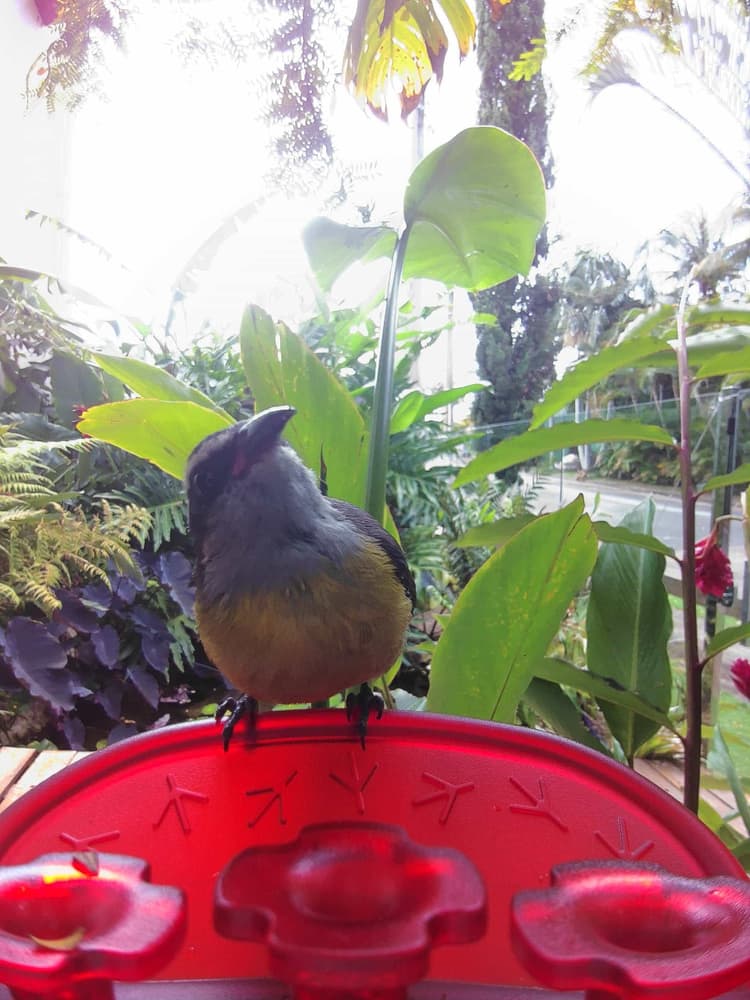
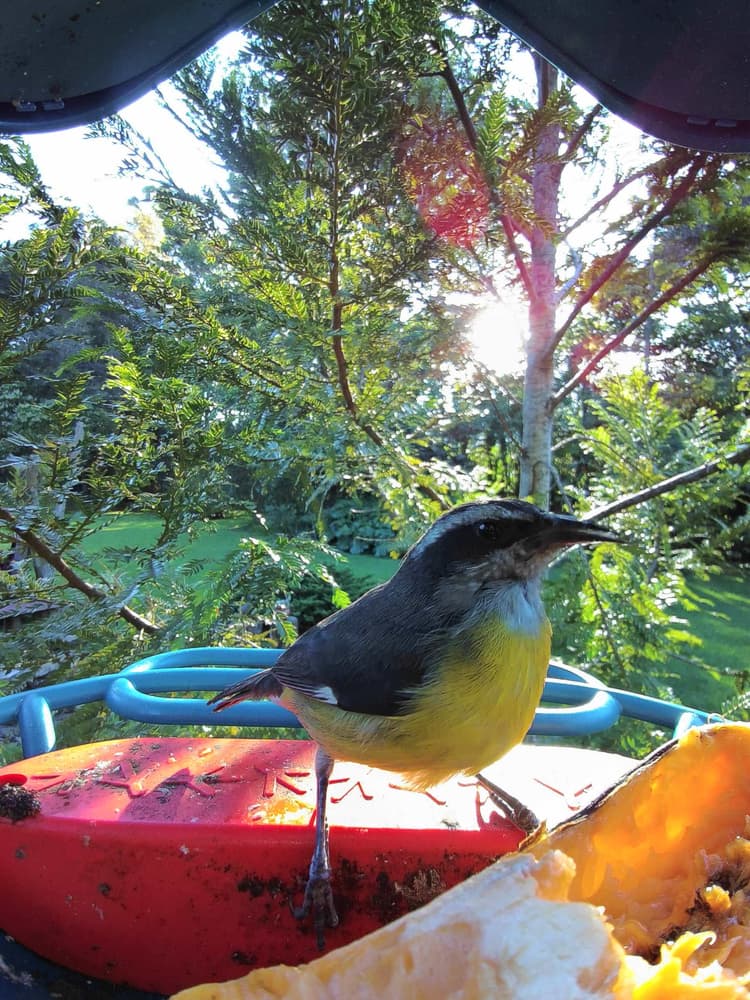
Male vs female
There are no significant differences visible between male and female bananaquits. Both genders share the same striking coloration: black, gray, red and white, with notable yellow parts. Hence, both males and females can be identified in the wild through these characteristics.
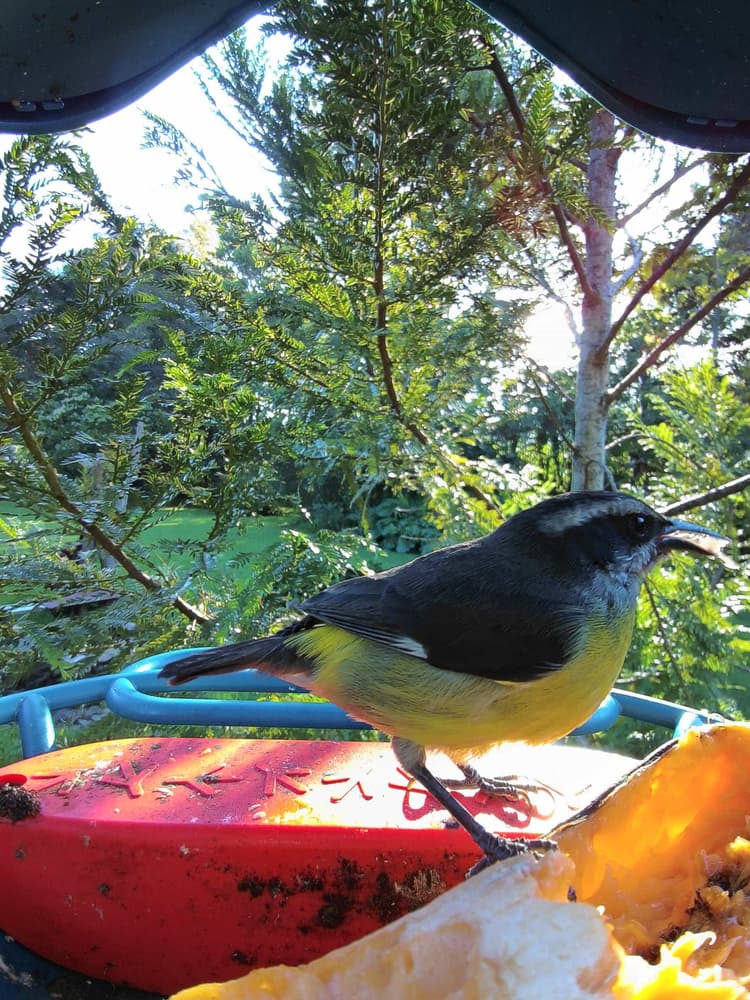
Male Bananaquit
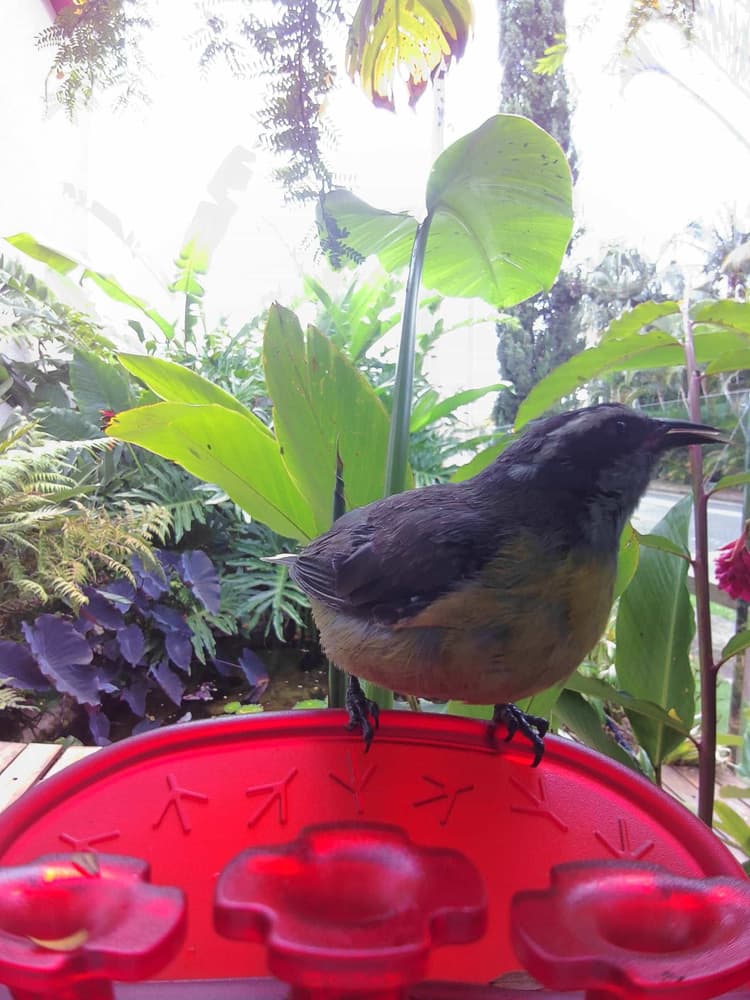
Female Bananaquit
Juvenile
Young bananaquits, or juveniles, lack the vibrant coloration of the adults. They are generally duller in their coloration, which makes them less noticeable. As they mature, their vibrant adult colors start to show, making them easier to spot as they reach adulthood.
Breeding and nesting habits of the bananaquit
Mating behaviors
Bananaquits typically engage in vocal displays and chase sequences during courtship. Males may sing to attract females, and the selection of a suitable mate often involves displays of agility and prowess in flight.
Nesting details
Bananaquits build globelike nests with a domed roof and side entrance. These nests are constructed from grasses, twigs, dead leaves, mosses, or other plant fibers and are typically placed in forks or at the end of branches in shrubs or trees. Nests are usually found 1.5–4 meters above the ground.
Eggs and chick-rearing
Eggs of bananaquits are small and typically speckled. Both parents are involved in feeding the chicks once hatched. The diet primarily consists of nectar and small insects, which are critical for the development of young bananaquits.
What does a bananaquit like to eat?
Berries
Fruits
Insects
Nectar
Natural diet
Bananaquits primarily consume nectar, which they obtain from flowers either by probing the flowers with their curved, pointed bills like hummingbirds or by piercing the base of the flower to let the nectar flow out. In addition to nectar, adult bananaquits eat small fruits and occasionally insects. Young birds are primarily fed insects by adults.
Bird feeders
At bird feeders, bananaquits are known to visit those designed for hummingbirds, where they can access nectar solutions similar to those they find in flowers.
Enticing treats for the bananaquit
This small bird can't resist the sweetness of fruits and nectar. Sugared water, oranges, and sugary fruits will most definitely catch their attention. Subtly keep these snacks in your yard or feeder, and watch as the bird makes a beeline to enjoy the feast. Another top-notch favorite are Bird Buddy seeds, carefully selected by experts according to the season, for the best results.
Crucial features of a bananaquit-friendly feeder
Feeder designs that allow the bananaquit to hang or perch upside down are the best, because this is their natural feeding behavior. Feeders with small feeding ports and lots of perching space will attract the bananaquit and allow easy access to those delectable treats.
Fun tips and tricks to coax the bananaquit
One trick is to place feeders close to their natural habitat, such as tree branches, as they’ll feel safer closer to cover. Secondly, establish a routine by refilling your feeders at the same time each day. After a while, you’ll notice your bananaquit visitors starting to show up around feeding time–making your yard their daily haunt. Oh and don’t forget to rev up your sing-along skills, you never know when you’ll get the chance to belt out a tune with your feathery visitors!
Where can you find bananaquits?
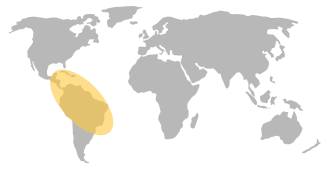
Primary habitat
The bananaquit primarily inhabits tropical and subtropical regions, including forest edges, gardens, and shrublands within the Caribbean, Central and South America.
Additional range
Occasionally found in urban environments and coastal areas, showcasing adaptability to different settings beyond typical tropical habitats.
Do they migrate?
The bananaquit is largely non-migratory and tends to stay in one place year-round. This tiny, nectar-feeding bird is commonly found across the Caribbean, as well as in parts of Central and South America. Its range includes a variety of habitats from coastal regions to forests, gardens, and urban areas. While bananaquits are generally considered resident birds, some minor local movements can occur in response to food availability, especially outside the breeding season. However, these movements are not considered true migrations and typically involve short distances. Overall, the bananaquit's adaptability to diverse habitats and its non-reliance on long-distance seasonal migrations contribute to its widespread presence across its range.
What is the role of bananaquits in nature and how to protect them?
Conservation status
The bananaquit is classified as "Least Concern" by the International Union for Conservation of Nature. Despite a decreasing population trend, the species remains common due to its extremely large range and population size, estimated between 5–50 million mature individuals. There are no significant immediate threats leading to a higher risk category. Consequently, specific conservation efforts may not be prioritized or discussed for this bird, given its non-vulnerable status. They have adapted well to various habitats, contributing to their stability and wide distribution.
Ecological role of bananaquits
Its role in the ecosystem
The bananaquit, a small Neotropical songbird, plays a vital role in its ecosystem. Its diet predominantly consists of nectar, which makes it an essential pollinator for various flowering plants, aiding in plant reproduction and biodiversity. Additionally, the bananaquit consumes insects and spiders, contributing to natural pest control by reducing the population of insects that could potentially harm plant life. This insectivorous behavior helps maintain a balanced ecosystem and supports agricultural health. Moreover, while less significant, bananaquits occasionally consume small fruits, facilitating seed dispersal. By moving seeds across their habitats, they promote genetic diversity and forest regeneration, enhancing ecosystem resilience. Overall, the bananaquit fosters ecosystem sustainability through its roles in pollination, pest control, and seed dispersal.
How to help protect bananaquits
Preservation tips
Habitat preservation strategies for bananaquit
Bananaquit conservation involves habitat preservation efforts. Secure and maintain habitats where bananaquit thrive, often tropical or densely vegetated areas, from deforestation or any other form of degradation. Preserve host plants like banana, hibiscus, and palm trees for the bird's nectar feeding. Create and enforce legislation to protect these areas and ensure sustainable use of resources.
Community science initiatives for bananaquit conservation
Engage the local community in bananaquit conservation through community science initiatives. Develop educational and awareness programs to inform the public about the importance of bananaquits and their role in maintaining a balanced ecosystem. Encourage locals to participate in bird-watching and collect data on bananaquit populations, their behaviors, and threats. This information can provide valuable insights for conservation strategies.