
Chukar
Chukar
Also known as: Chukar Partridge
Alectoris chukar


Quick Identification guide
Quick Identification guide
- •
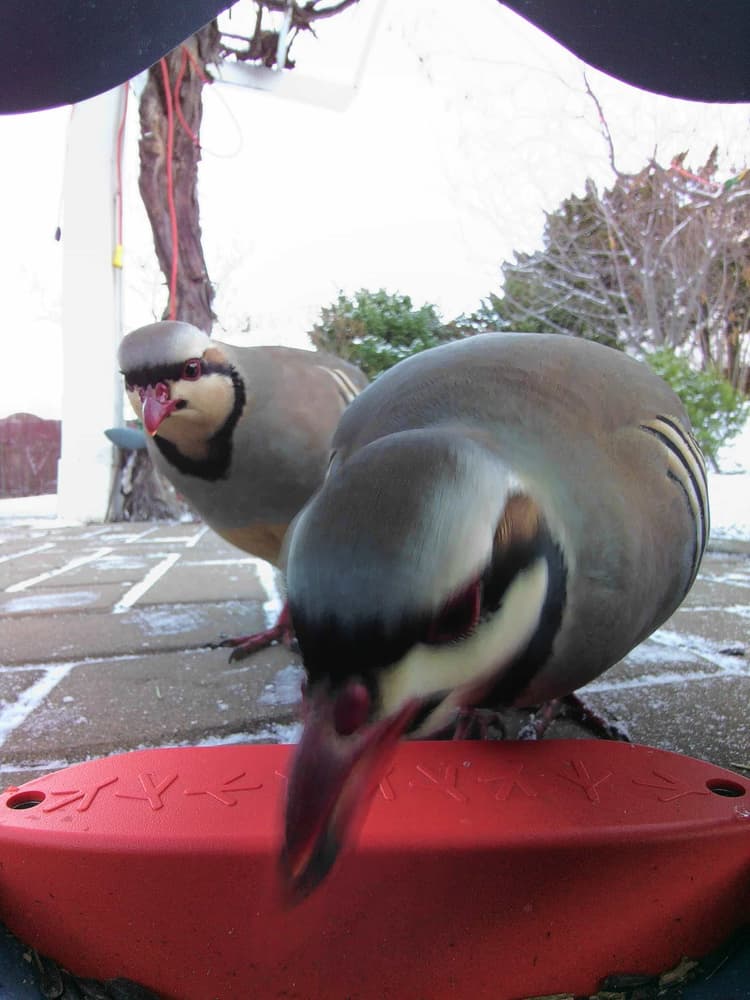
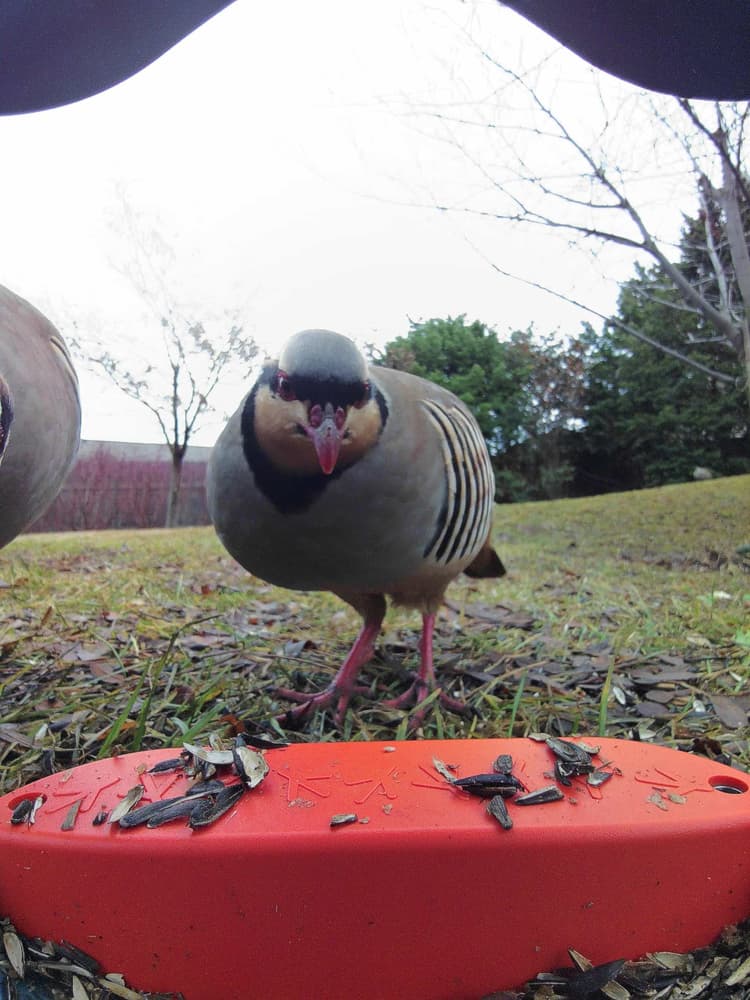
The plump, rounded body is decked with greyish-brown plumage and has a distinctive black eyeline that connects to a band across the neck
- •
Features bright red legs and a short, red bill, which contrast sharply with the rest of its natural camouflage
- •
Has white face markings with black edge, giving it a conspicuous appearance, especially around the head
What does a chukar sound like?
The Chukar, a game bird of the partridge family, typically exhibits a distinct and loud vocalization pattern marked by a rapid, rhythmic 'chuck-chuck-chuck' sound. This sound is fast-paced and can be recognized as its most typical call. The Chukar is also known for its diverse range of cackling calls, adding variety to its vocal repertoire. These cackles vary in sound, providing a broad spectrum of calls to communicate within its environment. Thus, the bird's vocalizations are characterized by their intensity and distinctive cackling calls.


Description
Chukars are the national bird of Pakistan and Iraq. These birds are quick, agile, and masters of camouflage: spotting them in the desert they call home can be quite the task! They are also resourceful and will wander into all sorts of places in search of water. Their favorite activity? Dust baths, which they take daily!
The chukar can weigh between 550to675grams and be from34to38centimeters tall.
The Chukar, a type of partridge, typically lives between 10 to 12 years in the wild. By comparison, this is similar to the lifespan of related species such as quails, pheasants and francolins. However, lifespan may depend on factors such as predators, disease, and habitat. In captivity, where many of these threats are mitigated, Chukars can live up to 16 years.
Did you know?
Most popular questions about chukar
How to recognise a chukar?
General appearance
The chukar is a crow-sized bird, typically measuring between 13-15 1/2 inches (33-39 cm). Notable for bold black bars on its flanks and a black outline around a pale throat. It also bears a distinct red bill and legs. The bird’s color palette includes black, brown, gray, red, tan, and white. Its wing shape can vary from fingered to rounded, or short, while its tail shape can be rounded, short or square-tipped.
Male vs female
There is not a significant difference between male and female chukars in physical appearance. Both sexes display the same coloration and the same distinctive characteristics including the bold black bars on the flanks, the black outline around pale throats, and red bills and legs.
Juvenile
Juvenile chukars generally have similar physical characteristics to adults. They possess the same coloration but may be slightly duller in appearance. Their size and color intensity increases as they mature into adults.
Often mistaken for
California Quail vs Chukar
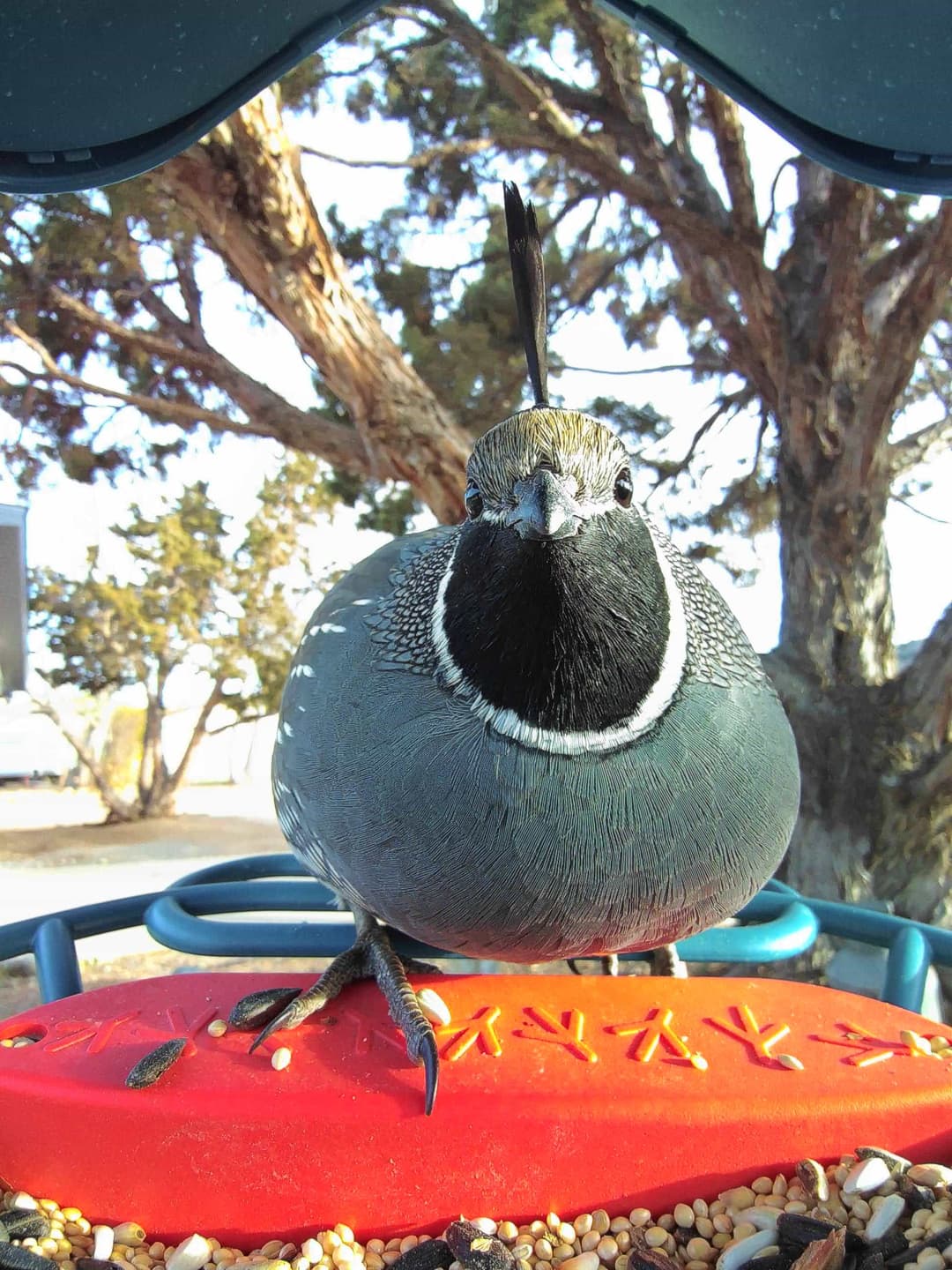
The Chukar and California Quail share similar habitats but differ in appearance. The Chukar is larger, with bold black and white stripes on its sides and a distinctive black band across its eyes. In contrast, the California Quail is smaller, with a characteristic forward-facing comma-like black plume on its head and a more scaled pattern on its belly. To distinguish them, look for the Chukar's rounder, stockier body compared to the more compact build of the California Quail.
Breeding and nesting habits of the chukar
Mating behaviors
During courtship, the male chukar displays by tilting his head and circling around the female. Both partners engage in mock feeding movements, and the male may also feed the female to strengthen pair bonds.
Nesting details
Chukars typically nest on the ground, choosing sites hidden under shrubs or near overhanging rocks. Their nests are depressions lined with grass, twigs, and feathers, providing a well-camouflaged and comfortable environment for the eggs.
Eggs and chick-rearing
After laying eggs, both parents may participate in incubating and rearing the chicks. They lead their young to feeding areas, often teaching them to forage.
What does a chukar like to eat?
Berries
Insects
Plants
Seeds
Natural diet
The chukar's diet primarily consists of seeds, leaves, and insects. Seeds from grasses and other herbaceous plants make up the bulk of their diet. They also consume berries and succulent plant materials when available. Insects like beetles and ants provide essential proteins, especially for young chicks. During the dry seasons or in arid habitats, chukar partridges may also feed on tender shoots and roots to obtain moisture.
Bird feeders
Chukars are less commonly seen at bird feeders than other bird species. However, when they do visit feeders, they generally consume grains and seeds such as millet, cracked corn, and sunflower seeds. They may be drawn to feeders located near open fields or areas that mimic their natural habitat, where they can easily access both feeder offerings and ground foraging.
Attracting chukars with the right food and feeder
Chukars are ground-foraging birds, hence placing your feeders at least a few feet off the ground will attract them. Offering a mix of grains is also a wonderful way to tempt them. Bird Buddy seeds are an excellent choice as they are carefully selected by birding experts for each season, making them irresistible to Chukars. Remember to keep the feeding area clean and the food fresh to keep them coming back.
Fun tricks to entice chukars
Chukars are curious creatures. If you want them to visit your yard often, adding movements to your backyard could pique their interest. You can hang some colorful wind chimes or set up a bird bath. The trickling sound of water tends to attract birds. Most importantly, make sure your yard is safe and free of predators. Create hiding places such as thickets or pile of branches where they can flee to if they sense danger.
Where can you find chukars?
Primary habitat
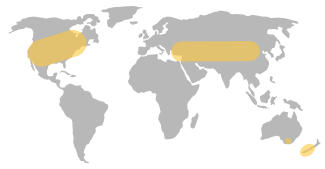
The chukar typically thrives in rocky, grassy or brushy slopes and arid mountainous or canyon areas. It prefers places where winter snow melts quickly like near rocky cliffs or steep canyon slopes.
Additional range
Although often found in very dry areas, the chukar may require access to water unless consuming sufficient green leaves. It thrives in grasslands mixed with sagebrush or saltbush, with introduced cheatgrass being a key element of its cover.
Do they migrate?
The chukar, a type of partridge, is generally a non-migratory bird within its native and introduced ranges. In North America, where it is an introduced species, the chukar is a permanent resident throughout its range, indicating that it stays in the same geographical areas year-round and does not engage in long-distance migration. In its native range across Eurasia, while the chukar is also largely sedentary, there are some seasonal movements observed. These movements are not comparable to long-distance migration but involve minor altitudinal shifts. In mountainous regions, chukars may move downslope during winter to avoid harsher conditions at higher elevations. Additionally, there are instances where they might invade nearby desert areas in winter, likely seeking more favorable climatic conditions or food availability. However, these movements are relatively limited and do not involve traveling large distances or crossing significant geographical barriers. Therefore, chukars do not follow specific migratory routes, timing, or key locations like typical migratory species. Their movements are more opportunistic and localized, driven by environmental factors such as temperature and food resources.
What is the role of chukars in nature and how to protect them?
Conservation status
The chukar is a common bird species, particularly in some regions of western North America where it is firmly established. It is not considered vulnerable or endangered. Key conservation efforts focus on habitat preservation and management to maintain its stable populations. Significant threats include habitat loss due to urban development and agricultural expansion. However, these have not critically impacted its overall survival due to its adaptability and strong populations across suitable habitats. Conservation measures continue to support its thriving status.
Ecological role of chukars
Its role in the ecosystem
The ecological significance of the chukar mainly lies in its feeding behavior and nesting habits. Predominantly a ground feeder, the chukar contributes to pest control by consuming insects, helping to regulate insect population. Their diet heavily consists of seeds, leaves, and berries; many of these being from introduced Eurasian plants like cheatgrass, Russian thistle, and Russian olive. This implies that the chukar may play a key role in seed dispersal, particularly for these introduced plants, aiding in their propagation. The chukar's foraging also fosters plant growth by boosting soil health. Chukars are likewise an essential part of the food chain, providing prey for various predators. Their grounded nests hidden under shrubs or rocks further aids in enhancing the soil's fertility. Given these diverse roles, the chukar has extensive ecological significance, contributing to their ecosystem via pest regulation, aiding in plant propagation, enhancing soil health, and supporting the food chain.
How to help protect chukars
Preservation tips
Habitat preservation strategies
Support the conservation of the Chukar by advocating for preservation of its natural habitats which include rocky, arid terrain often near water sources. Discourage development initiatives that disrupt these habitats, additionally promoting the restoration and preservation of these areas. Introduce regulations to limit hunting of the Chukar during its breeding season to protect population numbers.
Community science initiatives
Get involved in community science initiatives that focus on studying the Chukar. This may involve documenting sightings, tracking movements or studying behaviour patterns to add to collective knowledge about the species. Educate local communities about the importance of biodiversity and the specific roles the Chukar plays in the ecosystem. Collaborate with local schools and institutions to raise awareness and foster a culture of conservation.