
Fieldfare
Fieldfare
Turdus pilaris
Quick Identification guide
Quick Identification guide
- •
Features a grey head, nape, and rump, contrasting with its rusty-colored back and flanks
- •
Displays a distinctive white belly with black spotting on the breast, setting it apart in mixed flocks
- •
Boasts a yellowish beak and dark tail, which help to identify it from other thrush species
What does a fieldfare sound like?
The fieldfare, a member of the thrush family, has a distinct array of vocalizations. Its song is a mixture of harsh chuckles and melodious notes, including a loud 'chack-chack' often in rapid succession. Its alarm call resembles a harsh, rattling 'tsrrr'. Its song is less tuneful than other thrushes, but can include softer, more melodic warbling notes interspersed with the harsher sounds, usually performed from a prominent perch.
Description
Fieldfares are small songbirds. These strong and fast flyers are foragers and their name comes from the old Anglo-Saxon feld-fere which means traveller through the fields. They do love to travel and males have a series of calls that they make while they are airborne to communicate with their fellow flyers.
The fieldfare can weigh between 81to141grams and be from22to28centimeters tall.
The typical lifespan of a fieldfare, a type of thrush, is about 10 years. This is relatively long compared to other thrushes like the song thrush which has a lifespan of 3-5 years, and the mistle thrush that usually lives for 5 years. However, the lifespan of a fieldfare is considerably shorter than that of larger birds in the thrush family, like the American robin that can live for up to 14 years.
Did you know?
Most popular questions about fieldfare
How to recognise a fieldfare?
General appearance
The Fieldfare is a large, colorful thrush, with a prominent grey crown and nape, brown back, and rufous rump. It displays a distinctive black tail, speckled breast, and a bold off-white belly. Their wings are strikingly blackish-brown. The throat and sides of neck are grey, standing out against the darker colors. Their bill is dark and their legs are brown.
Male vs female
Males and females are similarly colored with no obvious differences. Both have the same pattern and share the distinguishing feature of fieldfares, which is their unique combination of colors - gray, brown, rose and white. Males might be slightly larger than females but it's usually not noticeable.
Juvenile
Young fieldfares have spotted, rather than speckled, underparts, which distinguishes them from adults. They also have a rudder and wing coverts edged with rusty orange. The overall color is more dull, lacking the bright mixture of grays and russets found in the adult plumage.
Breeding and nesting habits of the fieldfare
Mating behaviors
During courtship, fieldfares are vocal and exhibit aerial displays. Males often sing to attract females, showcasing their agility and strength. They may chase each other before pairing.
Nesting details
Fieldfares build cup-shaped nests, often in trees or shrubs. They use twigs, grass, and mud for construction, lining the interior with softer materials like moss. Although primarily in woodlands, they can nest in gardens if suitable cover is available.
Eggs and chick-rearing
Fieldfares lay 5 to 6 eggs per clutch, incubated by the female for about two weeks. Both parents feed the chicks, which fledge after roughly 14 days. Ensure garden habitats have dense shrubs and ample food sources for successful rearing.
What does a fieldfare like to eat?
Aquatic animals
Berries
Flowers
Fruits
Insects
Plants
Seeds
Snails
Spiders
Worms
Natural diet
Fieldfares primarily feed on a variety of insects and invertebrates during the breeding season, such as earthworms, beetles, and caterpillars. In winter, their diet shifts to predominantly fruits and berries, including rowan, hawthorn, and juniper berries.
Bird feeders
At bird feeders, fieldfares are known to consume fruits such as apples and pears. They may also eat grains and seeds if available, but they are not as common as other garden birds at feeders.
Offering the right food
Fieldfares enjoy a diverse menu, including insects, earthworms, berries, and fruits. However, their favorite seems to be apples. Try to scatter some chopped apples around your yard, or hang them from trees. When it comes to bird seeds, consider Bird Buddy seeds. These seeds are expertly selected for the season which draws fieldfare populations more effectively.
Ideal feeders
Fieldfares are ground feeders, so traditional hanging feeders won't tempt them. A bird table or a ground feeding station will be much more attractive. Sprinkle Bird Buddy seeds in these areas, or lay chopped apples out to lure them.
Creating a fieldfare-friendly environment
Aside from food, there are other tricks to stimulate fieldfares to visit your yard. They are often attracted by water sources, such as a shallow bird bath. Also, emulate their favorite habitats by providing bushes or hedgerows for shelter. Lastly, remember that quiet and undisturbed spots appeal to them. Minimize disturbances in your yard to keep them coming back.
Enjoying their visit
Fieldfares are known for their loud 'chack chack' calls, particularly in flight. Once you've attracted them to your yard, sit back and enjoy the song they bring. It's like they've come not only for a visit, but also for a sing-along.
Where can you find fieldfares?
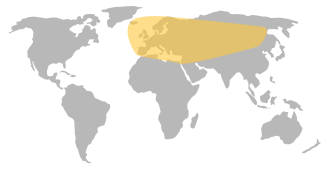
Primary habitat
Fieldfares typically inhabit deciduous and mixed forests in Northern Europe and Asia. They prefer temperate, seasonal climates.
Additional range
Unexpectedly, Fieldfares can also adapt to urban areas, farmlands, and even arctic regions during migration.
Do they migrate?
The fieldfare is a migratory bird native to Europe and parts of Asia. During the breeding season, which begins in late April, fieldfares inhabit northern regions, including Scandinavia, Russia, and parts of Eastern Europe. As autumn approaches, typically from September to November, they migrate southwest to escape the harsh winter conditions. The migration route of the fieldfare primarily leads them to Central and Western Europe, with substantial numbers wintering in the United Kingdom, Ireland, France, Germany, and the Low Countries. Some populations may even reach the Iberian Peninsula and the Mediterranean. Fieldfares typically migrate in flocks, sometimes mixed with redwings, another thrush species. Their migration timing and precise routes can vary annually based on environmental conditions and food availability. Key stopover sites along their migration route include areas rich in hedgerows, fields, and woodlands, where they can feed on berries and fallen fruit. In spring, around March and April, fieldfares return to their breeding territories in the north. This migratory behavior ensures they exploit seasonal food resources effectively while avoiding extreme weather conditions.
What is the role of fieldfares in nature and how to protect them?
Conservation status
The fieldfare is classified as "Least Concern" by the IUCN, indicating it is a common species with a stable population. It mainly breeds in northern Europe and migrates south during winter. While not currently threatened, its habitats could be affected by agricultural practices and climate change. Conservation efforts focus on habitat preservation and monitoring population trends. Key threats include habitat loss and changes in land use. In some areas, protection of nesting sites and management of farmland to support biodiversity are important for maintaining healthy populations of fieldfares.
Ecological role of fieldfares
Its role in the ecosystem
The fieldfare, a kind of thrush, plays a vital role in their ecosystem by contributing to both pest control and seed dispersal. Given their diet primarily contains invertebrates, including worms, beetles, and caterpillars, fieldfares naturally reduce the population of these species, thereby providing natural pest control which is important in maintaining the balance of the ecosystem. This is especially beneficial in agricultural areas, as it reduces the number of crops affected by these pests. Moreover, fieldfares are significant seed dispersers. They consume a range of fruits and berries, and the undigested seeds are expelled in different locations, aiding in the distribution and propagation of various plant species. Consequently, they help increase the vegetative cover, facilitating biodiversity. Thus, fieldfares are vital in maintaining ecological diversity and balance. Their decrease or loss could potentially lead to an overpopulation of certain pests and a lack of seed dispersal, leading to a decline in plant variety. This underscores the importance of their conservation.
How to help protect fieldfares
Preservation tips
Habitat preservation strategies
To support the conservation of fieldfares, engage in habitat preservation. This includes safeguarding their natural habitats like shrubs and forest edges from deforestation and environmental pollution. Restrict the use of pesticides in areas where fieldfares feed as it can deplete their food resources. Advocate for policies that protect wildlife habitats and support sustainable land use practices.
Community science initiatives
Participate in community science initiatives related to fieldfares. Report sightings to local biodiversity records centers to help track their range and population trends. Educate your community about the importance of fieldfares and their role in the ecosystem. Organize bird watching events to create awareness and foster appreciation for these birds. Encourage your community to install bird feeders and nesting boxes to provide additional resources for fieldfares, especially during harsh winter months.