
Rock Wren
Rock Wren
Salpinctes obsoletus

Quick Identification guide
Quick Identification guide
- •
The Rock Wren exhibits mottled gray-brown plumage with subtle patterns that blend well with rocky surfaces
- •
Features a short, slender, slightly curved beak tailored for foraging among rocks
- •
Has a compact, rounded body with a slightly upturned tail and short legs arranged for quick, agile movements among stones
What does a rock wren sound like?
The rock wren exhibits vocalizations characterized by a dry trill and rhythmic series of musical notes. Its call, often relayed as 'chewee' four times, varies in its pattern - sometimes falling, sometimes flat. The wren usually communicates through chirp, chip, trill or whistle calling types, employing a unique blend of sounds to express different meanings.

Description
If ever there was an awesome singer, it's the rock wren... It's basically in the name! These small and active birds have an impressive repertoire of over 100 song types! They aren't just amazing singers, they've got a flair for architecture, and will build an elaborate pavement leading to the hidden location of their nest. Why they do this remains a mystery so far!
The rock wren can weigh between 15to18grams and be from12.5to15centimeters tall.
The typical lifespan of a rock wren, a small passerine bird native to the Americas, is about six years on average, but it can live up to a decade in the wild. Compared to many related species in the Wren family, such as the house wren living up to seven years, and the Carolina wren with a maximum reported age of 14 years, the rock wren's lifespan falls within a similar range.
Did you know?
Most popular questions about rock wren
How to recognise a rock wren?
General appearance
The rock wren is a small bird measuring about 12 to 15 cm in length. It has a distinctive plump body with a slightly curved bill. Its overall coloration is light brown to grayish with a mottled, speckled pattern across its back, offering excellent camouflage against rocky environments. The underparts are generally pale with a subtle buff tint, and a faint, rust-colored wash is present on its flanks. Its tail is short yet expressive, usually kept cocked upright.
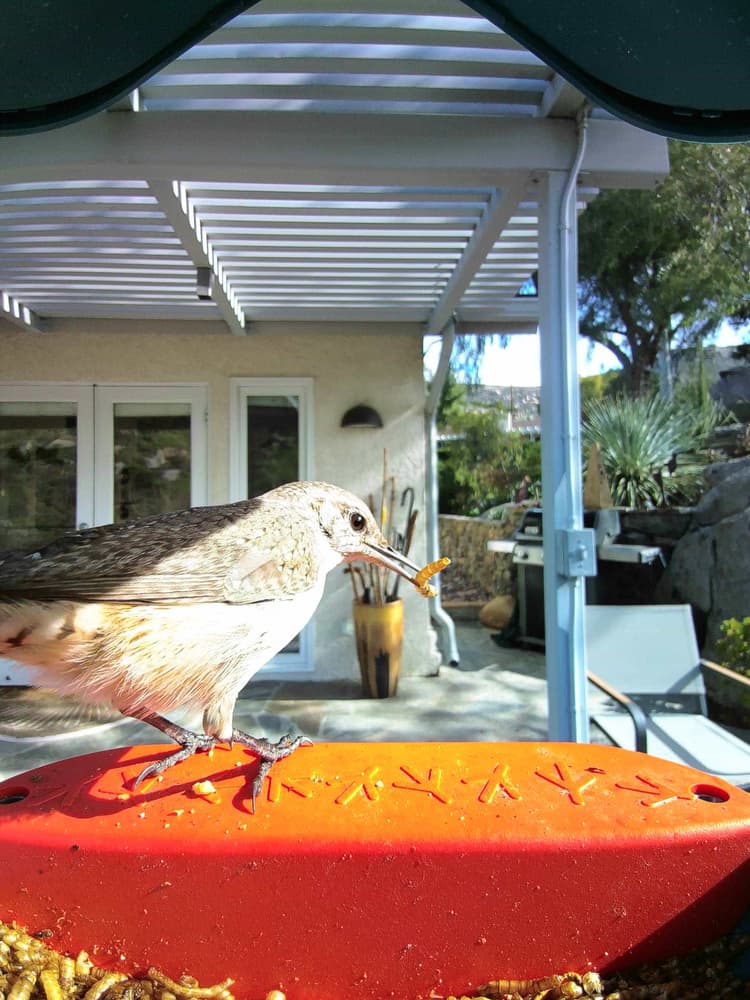
Male vs female
Sexual dimorphism is minimal in rock wrens, making it challenging to differentiate between males and females based on appearance alone. Both genders share similar plumage colors and patterns, and any differences are subtle at best, mainly reflected in behavior rather than physical traits.
Juvenile
Juvenile rock wrens closely resemble adults but tend to have more diffuse and less distinct speckling. Their overall plumage may appear slightly duller with less contrast between the upper and lower body. As they mature, their coloration gains definition and takes on the more distinct pattern typical of adults.
Breeding and nesting habits of the rock wren
Mating behaviors
The male rock wren sings to defend its nesting territory. Display behavior during courtship is not well documented but likely involves vocalizations and aerial displays.
Nesting details
Rock wrens nest in crevices among boulders, dirt bank holes, under rock ledges, or in cavities of stone buildings. Rarely, they use tree cavities. Nests are cups made of grass, weeds, bark strips, twigs, and rootlets, lined with finer materials like animal hair and feathers. A unique feature is the "paving" of small stones, bones, and debris at the entrance.
Eggs and chick-rearing
Specific information on egg-laying and chick-rearing is limited. Both parents likely participate in feeding the chicks. Ensuring a safe, hidden location for the nest in a garden can help support this species.
What does a rock wren like to eat?
Aquatic animals
Insects
Seeds
Small animals
Spiders
Natural diet
The rock wren primarily consumes a diet consisting mainly of insects and spiders. Its diet is not well-documented but is believed to include beetles, ants, grasshoppers, various other insects, and spiders. The rock wren may also eat other arthropods, indicating a preference for small invertebrates found in its natural rocky habitat.
Bird feeders
There is no specific information suggesting that rock wrens frequent bird feeders. They generally rely on natural food sources such as insects and spiders found in their rocky, natural environments. Bird feeders typically do not attract rock wrens as their diet consists mostly of live prey rather than seeds or typical bird feeder fare.
Attracting rock wrens: the perfect snacks
To attract Rock Wrens to your yard or feeder, it's essential to stock up with their favourite snacks which include small insects, spiders, and even snails. If available, always choose Bird Buddy seeds as they tend to yield the best results. Bird Buddy seeds are expert-selected for each season to suit the nutritional needs of the birds.
Ideal feeders for rock wrens
Rock Wrens prefer feeders that offer a flat, open area where they can hop around while they eat. Platform or tray feeders are typically the most successful. Make sure the feeders are located near the ground since Rock Wrens are ground feeders in the wild. But, keep them in a safe distance away from bushes or places where predators can hide.
Fun tricks to keep rock wrens around
To make your yard more inviting and encourage the Rock Wrens to stick around, consider adding a small, shallow birdbath or a dust bath area to mimic their natural habitats. These birds also like to nest in rocky outcrops and crevices, so creating a similar environment in your yard can make a huge difference. With these tricks, you will have an audience ready for your sing-alongs in no time!
Where can you find rock wrens?

Primary habitat
The rock wren predominantly lives in rocky environments, from low canyons to lofty mountain heights. It prefers open and arid landscapes but is less prevalent in scorching desert areas during summer.
Additional range
In winter, the rock wren adapts to lower, rocky elevations, often found near dams. Lacking rocks, it may establish territories around hay bales, farm equipment, or other landmarks.
Do they migrate?
The Rock Wren is strongly migratory, particularly those residing in the northern portions of its range. During the warmer months, it inhabits areas across the western United States, including states like Wyoming, Montana, and perhaps into southern Canada. As winter approaches, these northerly populations migrate southward to escape the colder climate. This southward journey typically leads them to milder regions such as the southwestern United States and northern Mexico, where the winter conditions are more favorable for their survival. Interestingly, some individual Rock Wrens exhibit atypical migratory behavior by straying eastward during the fall. While such occurrences are rare, these wanderers have occasionally been spotted as far as the Atlantic Coast. This straying behavior indicates that, while the majority follow a southward path, some individuals may occasionally disperse in an easterly direction, possibly due to environmental factors or navigational errors. Overall, the Rock Wren's migration is a north-south pattern primarily, with some individuals deviating towards the east, showcasing the species' adaptability and response to environmental cues.
What is the role of rock wrens in nature and how to protect them?
Conservation status
The rock wren is widespread and common, with stable population numbers. Its nesting habitats are largely unaffected by human activities, suggesting it is not currently vulnerable or endangered. Key to its conservation status is the minimal impact of human encroachment on its environment, which supports its stable numbers. As such, no significant conservation efforts are urgently required, and there are no major threats jeopardizing its population or habitat at this time.
Ecological role of rock wrens
Its role in the ecosystem
The Rock Wren plays an essential role in the ecosystem through pest control. Its diet primarily consists of insects and spiders, including beetles, ants, and grasshoppers. Feeding on these populations can help keep them under control, preventing a potential overpopulation of these pests. Their foraging behavior also contributes to soil dynamics and nutrient cycling as they probe in crevices among rocks or other areas on the ground such as dirt banks and rocky cliffs. This activity could potentially aid in the distribution of seeds in the areas they inhabit. However, their diet and feeding behavior are not well-known, so their entire impact on the ecosystem remains unclear. Despite this, their contribution in controlling pests is evident and crucial in maintaining the balance in their habitats.
How to help protect rock wrens
Preservation tips
Habitat preservation strategies
Maintain and preserve rocky or scrub lands where these birds inhabit, as habitat loss is a principal threat. Restrict human activity in these areas during breeding season. Educate construction industry about the value of conserving natural rock formations and scrubs. Encourage use of 'bird-friendly' building materials to reduce window collision threats.
Community science initiatives
Involve local communities in rock wren conservation efforts. Conduct bird counting events and habitat health assessment projects, facilitating increased awareness and conservation action. Engage local schools and organizations in 'Adopt a Habitat' programs to instill stewardship. Partnerships with universities and research bodies can support ongoing species monitoring and habitat study.