
Sharp-Shinned Hawk
Sharp-Shinned Hawk
Accipiter striatus
Quick Identification guide
Quick Identification guide
- •
The slim body and short, rounded wings set it apart from other hawks
- •
Features long, narrow tail with prominent dark bands for quick maneuverability in flight
- •
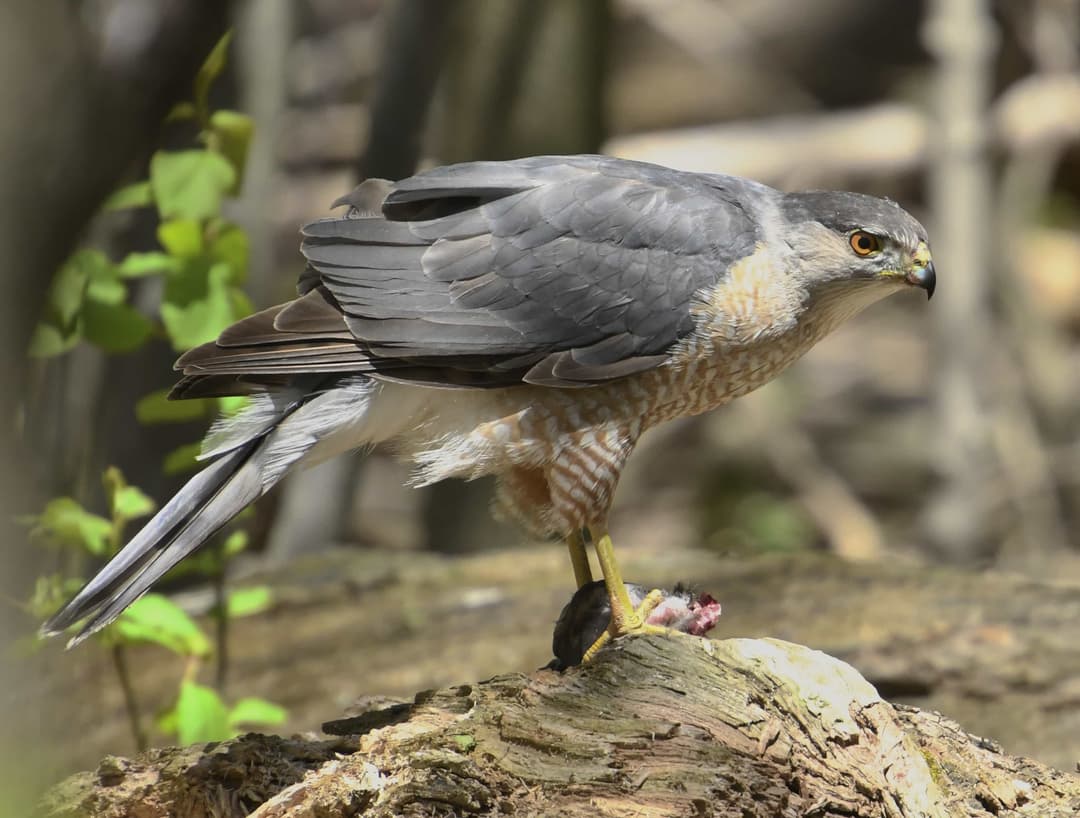
The gray-blue back contrasts with its rusty-barred chest and bright yellow eyes
What does a sharp-shinned hawk sound like?
The sharp-shinned hawk vocalizes with sharp, repeated "kik-kik-kik-kik" calls, often resembling chatter. It is also known for its shrill scream that usually follows a simple, flat, falling pattern. These distinct sounds enable this hawk species to communicate effectively within its habitat.
Call
Audio by G. McGrane
Description
Female sharp-shinned hawks are about a third heavier and bigger than males! Both parents feed chicks; males do so first, when they're little. They go and grab a snack along the way, removing and eating the head. When the chicks get bigger, it's mum's turn. They keep feeding the kids after they fledge: first, they dump food into their nest, later, they pass it to them mid-air.
The sharp-shinned hawk can weigh between 87to239grams and be from23to34centimeters tall.
The sharp-shinned hawk typically lives up to 20 years in the wild. This is comparable to the lifespan of its close relative, the Cooper's hawk, which averages around 20 years in the wild as well. However, the sharp-shinned hawk's lifespan is longer than another related species, the American kestrel, which often lives around 15 years in the wild.
Did you know?
Most popular questions about sharp-shinned hawk
How to recognise a sharp-shinned hawk?
General appearance
The sharp-shinned hawk is approximately the size of a crow, measuring 10-14 inches and sporting a wingspan of 21 inches. Their coloration varies between a blue-gray on top and pale reddish hue below. They are characterized by their squared-off tail tip and small heads. Their legs are pencil-thin, and they exhibit a broad, rounded wing shape, with a long and square-tipped, notched tail.
Male vs female
While generally small, female sharp-shinned hawks can escalate to almost the same size as a male Cooper's Hawk. The size parody among the species sometimes makes a distinction in the field perplexing and demands expert birding skills.
Juvenile
Young sharp-skinned Hawks differ from adults in coloration, starting as brown above with striped markings below. Compared to young Cooper's Hawks, juveniles of this species may demonstrate more blurry streaking on their lower-body. Over time, these youthful streaks gradually give way to the monotone, pale reddish coloration of their underside observed in adulthood.
Often mistaken for
Cooper’s Hawk vs Sharp-Shinned Hawk
Sharp-Shinned Hawks are smaller than Cooper’s Hawks, with shorter and more squared tails. Their legs are also notably thinner. Juvenile Sharp-Shinned Hawks have finer streaking on their underparts compared to the heavier streaks on young Cooper’s. In flight, Sharp-Shinned Hawks show quicker, snappier wingbeats, while Cooper’s Hawks have more drawn-out, powerful flaps. Pay attention to head shape: Cooper’s Hawks have a more defined cap and nape, creating a block-headed appearance. To be sure, the Sharp-Shinned Hawk often appears more delicate with a less prominent head.
Breeding and nesting habits of the sharp-shinned hawk
Mating behaviors
Sharp-shinned hawks engage in aerial displays involving acrobatics and chases during courtship. The male presents food to the female as part of courtship feeding, reinforcing pair bonds.
Nesting details
They prefer dense coniferous or mixed forests with secluded spots for nesting. Nests are typically built 20 to 60 feet above ground in tall trees, using twigs and lining them with bark strips. Although they are less common in gardens, they may use them if large trees are available.
Eggs and chick-rearing
The female lays 3 to 8 eggs, incubating them mostly herself while the male provides food. Incubation lasts about 30 days. After hatching, both parents feed the young, with the chicks fledging 3 to 5 weeks later. Creating a garden habitat requires tall trees and minimizing disturbances to encourage nesting.
What does a sharp-shinned hawk like to eat?
Birds
Insects
Small animals
Natural diet
The sharp-shinned hawk primarily preys on small birds, focusing on species approximately sparrow-sized up to robin-sized, and occasionally up to quail-sized. Their diet is supplemented with small mammals such as rodents, bats, and squirrels. Reptiles and amphibians form a minor part of their diet, including lizards, frogs, and snakes. Additionally, large insects are sometimes consumed.
Bird feeders
Sharp-shinned hawks are known to visit backyard bird feeders, primarily to prey on the small birds that frequent these areas. They do not consume seeds or other typical bird feeder offerings but are attracted by the presence of potential prey.
Attracting the sharp-shinned hawk
Attracting sharp-shinned hawks to your yard can be a fun and rewarding experience. These majestic birds are a sight to behold and having them visit your yard regularly can turn it into your very own nature reserve.
Favorite feeder and snacks
Sharp-shinned hawks are carnivorous; their diet mainly comprises small birds, and sometimes small mammals. To attract them, use large platform feeders that can accommodate small birds, because they serve as natural bait. As for the snacks, there is no particular brand of bird food that will attract these raptors, since they hunt live prey. Instead, keep your feeders stocked with Bird Buddy seeds to attract a variety of small birds, and the sharp-shinned hawk will soon follow.
Creating a sharp-shinned hawk friendly environment
You can increase the likelihood of a hawk visit by creating an environment that's friendly to them. This includes having tall trees for perching and nesting, and a water source like a bird bath or a pond. Keeping the surroundings clean and providing a quiet, peaceful ambiance will also help. Remember, sharp-shined hawks are wild animals, a little patience and persistence can go a long way.
Bird buddy seeds
We recommend Bird Buddy seeds as they are chosen by experts for all seasons. These seeds attract a variety of small birds, thereby increasing the chances of attracting sharp-shinned hawks into your yard. So, do give it a try and enjoy birdwatching!
Where can you find sharp-shinned hawks?
Primary habitat
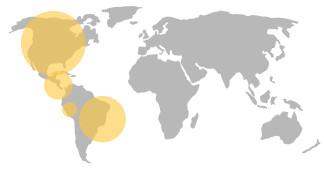
Sharp-shinned hawks primarily inhabit mixed or coniferous forests and open deciduous woodlands. They often choose to nest in groves of coniferous trees within mixed woods or dense deciduous trees.
Additional range
In winter, they can be found in any forest or brushy area, avoiding open country. Also, they sometimes reside in pure coniferous forests with nearby brush or clearings.
Do they migrate?
The sharp-shinned hawk is primarily a migratory species, although some populations in the northwest may consist of permanent residents. These hawks do not migrate in flocks but as individual birds. During migration, they often follow specific routes along coasts or ridges, particularly when weather conditions are favorable, such as during cold fronts with northerly winds that facilitate their southward journey. The migration of sharp-shinned hawks generally occurs in two main periods: fall and spring. In the fall, they leave their northern breeding grounds across Canada and the northern United States, heading towards the southern United States, Mexico, and Central America. Migration peaks in September and October. Key observation points for their migration in the fall include Hawk Ridge in Minnesota, the ridges of the Appalachian Mountains, and various coastal sites along the Atlantic. In the spring, the migration northwards to their breeding territories peaks around March and April. They again travel individually, influenced by similar weather conditions, making use of thermal uplifts and geographical features to aid their journey. These migratory patterns and behaviors contribute to varied concentrations of sharp-shinned hawks at prominent migration observation sites.
What is the role of sharp-shinned hawks in nature and how to protect them?
Conservation status
The sharp-shinned hawk experienced a population decline in the mid-20th century due to DDT and pesticide use, but numbers improved by the early 1980s. However, eastern populations have declined significantly since then. Currently, the hawk is not considered endangered but faces potential threats from habitat loss and environmental contaminants. Conservation efforts focus on habitat protection and monitoring pesticide levels to ensure stable populations. Overall, while not classified as endangered, continuous monitoring is crucial to prevent further decline.
Ecological role of sharp-shinned hawks
Its role in the ecosystem
The Sharp-shinned Hawk plays a crucial role in managing and balancing the ecosystem. It is a predator that primarily feeds on smaller birds and occasionally on small mammals and reptiles. By hunting these creatures, it aids in controlling the population of these species, thereby providing an essential service in the natural cycle of predator-prey interactions. Its feeding habits also naturally control pest populations, such as large insects and rodents. These hawks indirectly participate in seed dispersion as the birds they prey on are often seed carriers. Though not explicitly mentioned, the Sharp-shinned Hawk also contributes to nutrient cycling in the ecosystem through the decomposition of its organic waste. Additionally, these hawks are indicator species — changes in their population can indicate shifts in the overall health and diversity of the ecosystem, providing vital information for environmental monitoring. Thus, the Sharp-shinned Hawk contributes to pest control, seed dispersal, nutrient cycling, and environmental health surveillance.
How to help protect sharp-shinned hawks
Preservation tips
Preservation of sharp-shinned hawk habitats
Implement strict regulations to protect forests and other natural habitats of the sharp-shinned hawk. This includes limiting human intrusion and activities that cause disruption such as logging and construction. Encourage reforestation efforts especially in areas that have been previously inhabited by these hawks. Avoid usage of pesticides that indirectly harm this species by affecting their prey.
Community science initiatives for sharp-shinned hawk conservation
Involve community in citizen science projects to monitor the hawk populations, nest sites and migration patterns. Raise awareness about their endangered status and the importance of their conservation. Organize workshops and training sessions to equip community members with skills necessary to contribute effectively towards conservation initiatives. Promote platforms that allow people to report sightings and other relevant data concerning sharp-shinned hawks.