
Yellowhammer
Yellowhammer
Emberiza citrinella


Quick Identification guide
Quick Identification guide
- •
Features bright yellow plumage on the head and underparts, with contrasting brown streaked back and wings
- •
Exhibits a slender, conical beak typical of seed-eating birds
- •
Displays a long, forked tail which aids in stable flight
What does a yellowhammer sound like?
The Yellowhammer's typical song is a repetitive, rhythmic series of short notes, described as "a-little-bit-of-bread-and-no-chee-se". It also produces sharp "tsit" or "tik" calls. Their songs vary between individual birds, with subtly different rhythm or note patterns. They recite shorter songs at dawn and longer versions during the day. Predominantly males, they engage in singing mostly during breeding season. Sounds are clear, melodic and often described as cheerful.


Description
The rhythm of the yellowhammer's song is pretty easy to memorise, just keep the phrase, 'a little bit of bread and no cheese,' in mind! These beautiful birds have influenced artists for centuries, such as Robert Burns and even Beethoven! Did you know they have dialects? Yep, because they learn their song from their father, this led to the development of regional dialects!
The yellowhammer can weigh between 20to36.5grams and be from16to17centimeters tall.
The yellowhammer, an European bird species, typically lives up to 3 years. However, the oldest known individual lived for over 13 years. In comparison, related species like the corn bunting and reed bunting have similar lifespans, with averages between 2-5 years. Other Emberiza species, to which yellowhammer belongs, also exhibit similar lifespan ranges.
Did you know?
Most popular questions about yellowhammer
How to recognise a yellowhammer?
General appearance
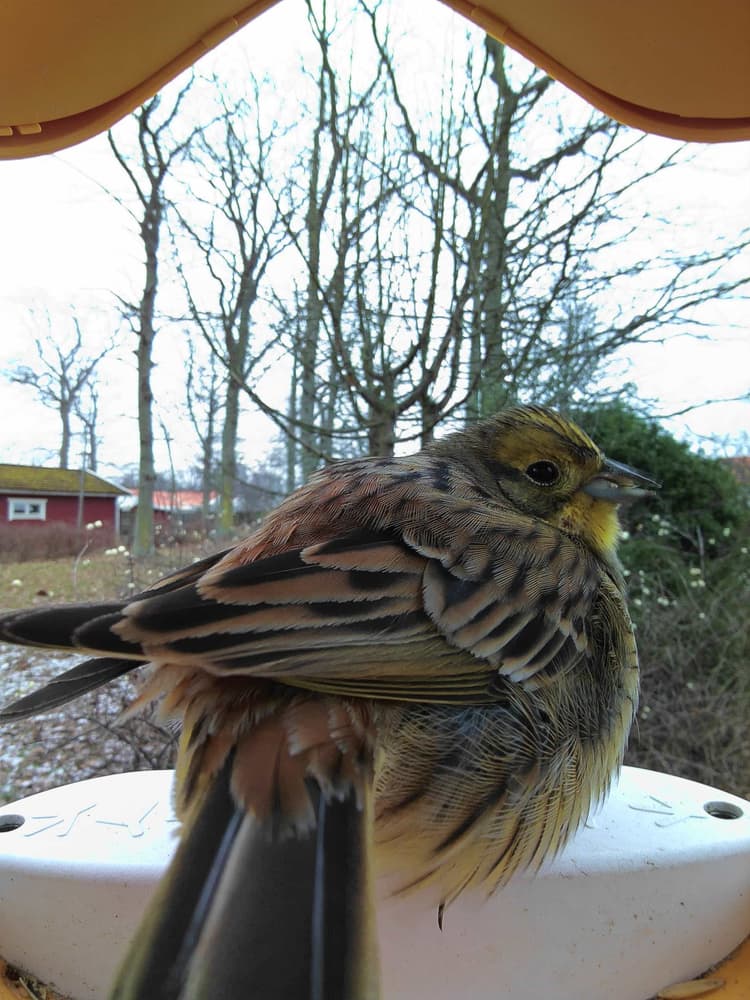
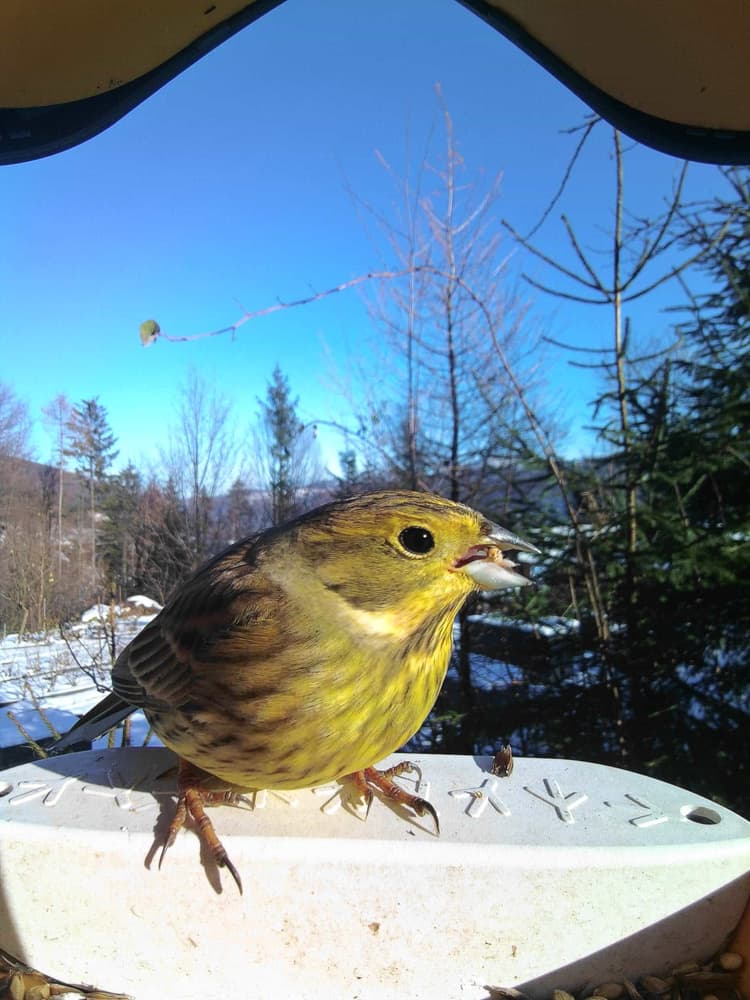
Yellowhammers are small, bright-colored birds, predominantly yellow with a bit of brown streaking on its back and a brighter yellow belly. The wings have a sparrow-like pattern with brown, white, and sometimes pink streaks. Females can be similar to males but are generally not as brightly colored.
Male vs female
Male yellowhammers sport a bright yellow head, chest and underparts contrasting with a reddish-brown back. In breeding season, the males display an intense coloration which fades as the season comes to an end. In contrast, females are less colorful with more subdued yellow hues and darker streaks.
Juvenile
Juvenile yellowhammers bear more resemblance to females, being less bright with more brown streaks on their back. Their breast and belly are a dull yellow. They gradually acquire adult plumage over time, with male juveniles attaining their brighter colors after their first summer.
Breeding and nesting habits of the yellowhammer
Mating behaviors
Yellowhammers engage in a mating ritual where males display vibrant yellow plumage and sing from prominent perches to attract females. Courtship includes aerial displays and songs.
Nesting details
Yellowhammers typically nest close to the ground in hedgerows or open fields. Nests are cup-shaped, made from grass, stalks, and hair. They are well-hidden among vegetation.
Eggs and chick-rearing
Females lay 3-5 eggs per clutch, incubating them for 12-14 days. Both parents feed the chicks, which fledge after about 11-13 days. Yellowhammers may re-nest several times per season.
What does a yellowhammer like to eat?
Berries
Insects
Seeds
Snails
Spiders
Worms
Natural diet
The yellowhammer primarily consumes a diet comprised of seeds, grains, and insects. During the breeding season, which falls in the warmer months, insects become a significant portion of their intake, providing essential proteins for rearing young birds. Common insects in their diet include beetles and caterpillars. In winter, they rely heavily on seeds and grains, which they find on the ground or directly from plants.
Bird feeders
Yellowhammers are commonly attracted to bird feeders, especially during colder months when natural food is scarce. At feeders, they are known to consume mixed bird seed, millet, and cracked corn. They may also benefit from fat balls and other high-energy food offerings available in backyard feeders, especially if these offerings include seeds.
Feeder types & food
To attract yellowhammers to your yard or feeder, start by selecting the right feeder types. Tube feeders or platform feeders are a great choice as they mimic natural feeding conditions for these birds. For food, yellowhammers are particularly fond of seeds, and Bird Buddy seeds are a fantastic option. These seeds are expertly selected for the season, which will help entice the yellowhammer.
Shelter and habitat
Yellowhammers also need suitable habitat and shelter, so you might want to include native trees, shrubs, and grasses in your yard. Providing a diverse habitat not only attracts these birds but also offers them a safe place to nest and take shelter.
Water sources and fun tricks
Adding water sources, like a bird bath or a shallow pond, can attract yellowhammers. An interesting trick is to install a 'bird mirror'; yellowhammers are curious birds and will often investigate their own reflection.
Bird song playback
Lastly, consider playing yellowhammer bird songs as this can encourage them to drop by for a visit and a sing-along! Just be careful not to disturb other wildlife in the area with the playback.
Where can you find yellowhammers?
Primary habitat
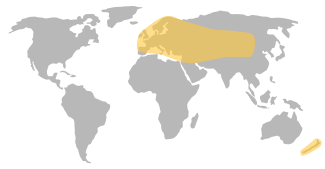
The yellowhammer primarily inhabits hedgerows and farmland across Europe and Asia. They prefer open countryside with bushes for nesting.
Additional range
In New Zealand, an introduced population successfully adapted to the local environment, showing the species' ability to colonize unexpected habitats.
Do they migrate?
The yellowhammer (Emberiza citrinella) is primarily a resident bird across much of its range, but its behavior can vary by region. In the UK and much of western Europe, yellowhammers typically stay in place year-round, forming flocks in the winter to stay warm and find food. However, populations in northern and eastern Europe exhibit migratory behavior. These migratory yellowhammers typically move southward in the autumn from places like Scandinavia and Eastern Europe to avoid harsh winters. Their migratory route tends to be short to medium distances, often moving to southern parts of their range in Europe, including southern France, the Iberian Peninsula, and sometimes North Africa. Migration generally begins in October, with birds arriving in wintering areas by November. They typically return to their breeding grounds starting in March or April. Key stopover and wintering locations vary but often include mixed farmland and open countryside where they can find seeds and grains. The intensity of their migration and specific routes can vary yearly, influenced by weather and food availability.
What is the role of yellowhammers in nature and how to protect them?
Conservation status
The yellowhammer is considered to be of "Least Concern" globally but is experiencing declines in some regions, notably in the UK where it is classified as a species of conservation concern. Key threats include agricultural intensification, which reduces available food and nesting sites, and habitat loss. Conservation efforts focus on habitat management, such as restoring hedgerows and winter stubble fields to provide food and shelter. Agri-environment schemes that promote wildlife-friendly farming practices are crucial in aiding population recovery. While still common in parts of Europe, ongoing conservation measures are needed to address regional declines and sustain populations.
Ecological role of yellowhammers
Its role in the ecosystem
The Yellowhammer (Emberiza citrinella) is a small bird native to Eurasia that plays a significant role in its ecological context. It primarily feeds on insects during the breeding season, functioning as a natural pest controller that helps to control insect populations, including crop pests, thereby benefiting farmers and the agricultural sector. In the non-breeding season, it feeds largely on seeds, contributing notably in seed dispersal, which is critical for the propagation of a variety of plant species and maintaining biodiversity. Furthermore, the Yellowhammer’s nesting habits also help to regulate populations of small predators, as nests can potentially be raided by animals such as stoats or weasels. Lastly, being a common farmland bird, changes in the Yellowhammer's population can indicate changes in the health of the rural ecosystem, acting as a valuable bioindicator.
How to help protect yellowhammers
Preservation tips
Habitat preservation strategies for yellowhammer
Focus on maintaining and creating open, uncultivated spaces like meadows and pastures. Prevent overgrowth by incorporating light grazing or regular cutting. Manage hedgerows, allowing some to grow tall and less dense, providing nesting sites. Limit use of pesticides to help ensure enough food sources like seeds and invertebrates.
Community science initiatives
Participate in bird monitoring surveys like the Breeding Bird Survey to provide valuable data on yellowhammer population changes. Encourage community-led 'nest box' programs which provide additional nesting sites. Promote an 'Adopt a Patch' initiative where locals manage selected areas to meet yellowhammer habitation requirements. Inform and educate the community about the importance of these birds and their conservation.