Rivoli's Hummingbird or Blue-Throated Mountain-Gem?
Here's how to tell the difference



Rivoli's Hummingbird

Blue-Throated Mountain-Gem
Rivoli's Hummingbird
Eugenes fulgens
General appearance
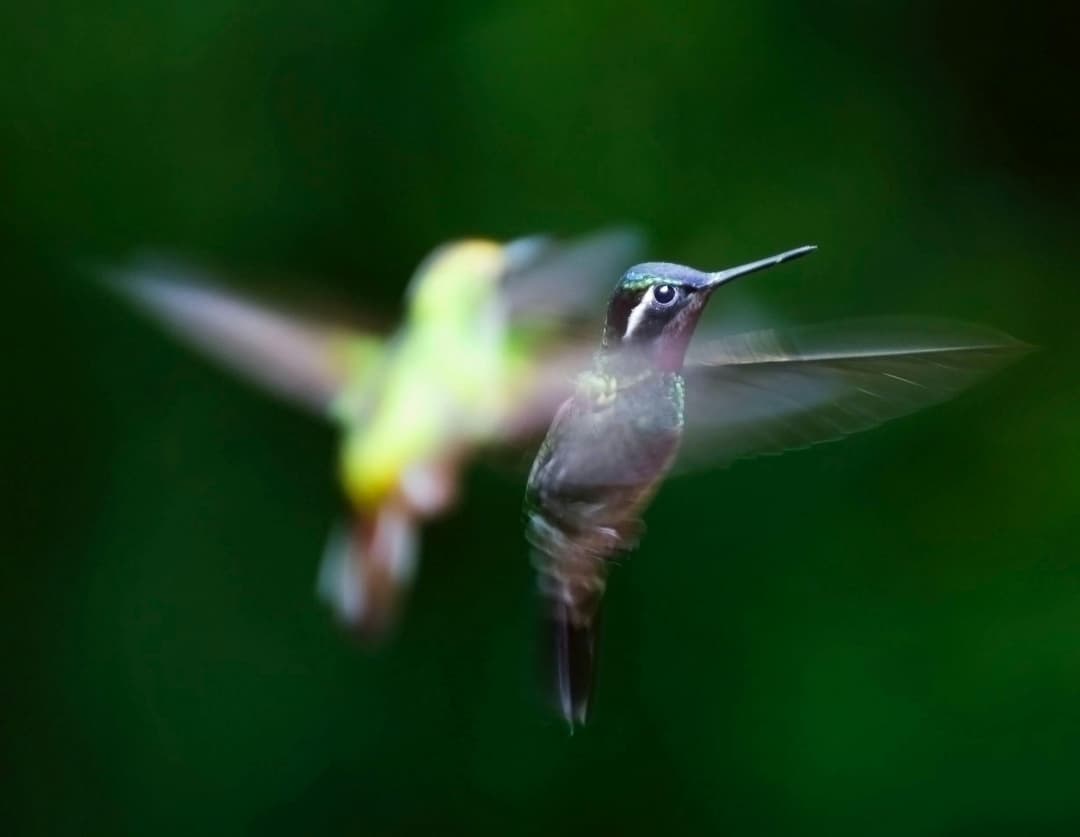
Rivoli's hummingbird is a large hummingbird with a straight, medium-length bill and vibrant plumage. Its deep green upperparts, combined with the iridescent emerald-purple crown, make it distinctive. The throat can appear black in dim light, which contrasts sharply with the rest of its vibrant plumage. When in flight, their wings beat rapidly, producing a unique humming sound.
Male vs female
Males are vividly colored with an emerald-green crown and throat, while their underparts are often darker. Females, on the other hand, have more muted colorations, lacking the vibrant green on the crown and throat; instead, they display a more subdued grayish-green. Both sexes have white spots behind the eyes. During the breeding season, males can be seen performing aerial displays to attract females.
Juvenile
Juvenile Rivoli's hummingbirds closely resemble females in coloration, typically displaying more subdued tones and less iridescence. They lack the striking crown feathers of the adult males. As they mature, the plumage becomes more vibrant. Juveniles might show gradual development of iridescent feathers typically as they transition into adulthood, especially noticeable during their first molting period.
Size
4.3 - 5.5 in/0.2 - 0.4 oz
There's more to learn about Rivoli's Hummingbird
View full detailsBlue-Throated Mountain-Gem
Lampornis clemenciae
Also known as: Blue-Throated Mountaingem, Blue-Throated Hummingbird
General appearance
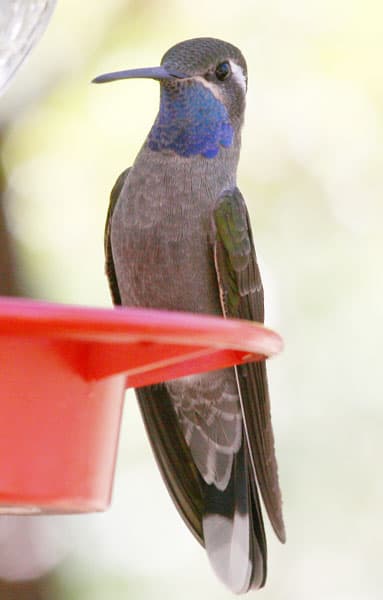
The blue-throated mountain-gem is a striking hummingbird with metallic green upperparts and a white breast. Its most distinctive feature is the iridescent blue throat patch that shines brightly in sunlight. The tail is rounded with white tips that are visible during flight, and it has a straight, medium-length bill.
Male vs female
Males are distinguished by their vibrant blue throat, which contrasts with a dark face mask. Their crown is a vibrant green, adding to their striking appearance. Females, however, exhibit more subdued coloration, lacking the blue throat of the males. Instead, they have a buffy throat and grey underparts with a less defined face mask.
Juvenile
Juvenile blue-throated mountain-gems resemble females but with even duller coloring. They lack the male's distinctive blue throat and have additional buffy edging on their feathers. As they mature, young males gradually develop their blue throat. Identifying juveniles in the wild can be challenging due to their muted colors compared to adults.
Size
4.5 - 4.9 in/0.2 - 0.4 oz
There's more to learn about Blue-Throated Mountain-Gem
View full detailsHow to tell the Rivoli's Hummingbird from the Blue-Throated Mountain-Gem
Visual differences
Rivoli's Hummingbird is larger, 4.3-5.5 inches in length, with a distinctive vibrant emerald-purple crown and throat, contrasting with darker underparts; females are grayish-green. The Blue-Throated Mountain-Gem is slightly smaller, 4.5-4.9 inches, with a metallic green crown and a striking blue throat; females have a buffy throat. Both species have medium-length straight bills, but Rivoli's hummingbird has a more uniform iridescent hue, while the Blue-Throated Mountain-Gem has a white breast and rounded tail with white tips.
Key differences and behavior
Rivoli's Hummingbird (Eugenes fulgens) and the Blue-Throated Mountain-Gem (Lampornis clemenciae) exhibit distinct behaviors and preferences. Rivoli's Hummingbird inhabits pine-oak forests from Nicaragua to the southwestern U.S., preferring wooded areas and engaging in "traplining" for nectar and insects. Despite its size, it is gentle and non-territorial. In contrast, the Blue-Throated Mountain-Gem, the largest U.S. hummingbird, favors shady canyons near water. It is known for its slower wing beat and duet singing during courtship. Both species build compact nests, but Rivoli's prefers higher, tree-based sites, whereas the Mountain-Gem utilizes sheltered, lower habitats. Their diets are similar, consisting of nectar and insects, both frequent feeders. They contrast mainly in habitat selection and courtship rituals.
Still not sure? Here are more lookalikes!
Rivoli's Hummingbird vs Black-Chinned Hummingbird
Rivoli's Hummingbird vs [Select a bird]

[Select a bird]
Pick a bird to compare
Blue-Throated Mountain-Gem vs [Select a bird]
[Select a bird]
Pick a bird to compare