Nashville Warbler or Tennessee Warbler?
Here's how to tell the difference



Nashville Warbler


Tennessee Warbler
Nashville Warbler
Leiothlypis ruficapilla
General appearance
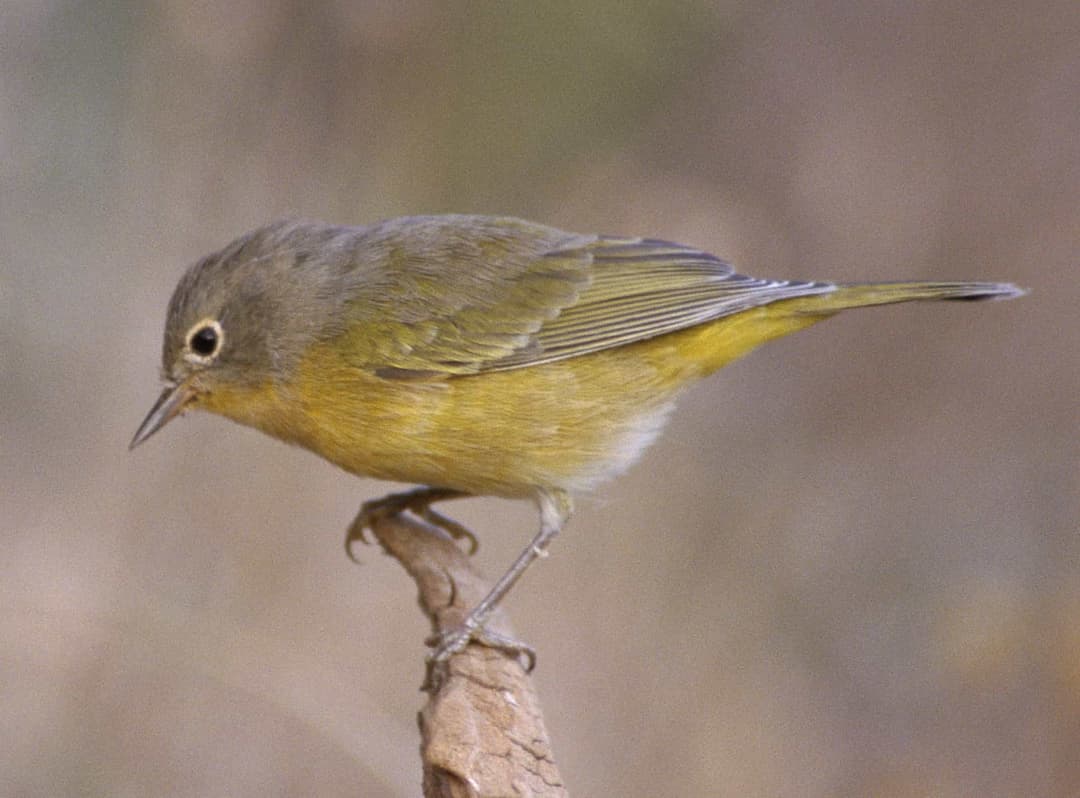
The Nashville warbler is a small songbird with olive-green upperparts and a bright yellow underside. It features a distinctive white eye ring and a gray head. The wings and tail are a darker shade of olive, and it has a thin, pointed bill ideal for insect hunting.
Male vs female
Both male and female Nashville warblers share similar coloration, though males are generally more vibrant. The male has a more pronounced gray head and may exhibit subtle rust tones on the crown and chest not seen in females. Females tend to have a slightly duller overall appearance.
Juvenile
Juvenile Nashville warblers resemble adults but with paler, less defined coloration. Their eye ring may be less distinct, and the yellow underside is more subdued. Juveniles lack the mature head patterns of adults, appearing more uniformly olive-gray.
Size
4.3 - 4.7 in/0.2 - 0.5 oz
There's more to learn about Nashville Warbler
View full detailsTennessee Warbler
Leiothlypis peregrina
General appearance
The Tennessee warbler (Leiothlypis peregrina) is a small songbird with a wingspan of about 8.5 inches. It features an olive-green back, gray to whitish underparts, and a pale eyebrow stripe. The wings are relatively plain with no wing bars. It has a sharp, short bill ideal for feeding on insects and nectar.
Male vs female
Males and females are visually similar, but males may exhibit slightly brighter olive-green coloration, especially during the breeding season. Both sexes display the characteristic pale eyebrow and lack distinct markings on their wings, making them challenging to differentiate.
Juvenile
Juvenile Tennessee warblers look similar to adults but tend to have a duller overall coloration. Their underparts may appear slightly buffy, and their plumage lacks the bright luster of adult birds. These differences lessen as the bird matures.
Size
3.9 - 5.1 in/0.3 - 0.4 oz
There's more to learn about Tennessee Warbler
View full detailsHow to tell the Nashville Warbler from the Tennessee Warbler
Visual differences
The Nashville Warbler has olive-green upperparts, a bright yellow underside, and a distinctive white eye ring with a gray head. Males are more vibrant, with potential rust tones. The Nashville has a slender, pointed bill and darker olive wings and tail, measuring 4.3-4.7 inches long. The Tennessee Warbler shows an olive-green back, grayish-white underparts, a pale eyebrow stripe, and no wing bars, with a sharp, short bill. It spans 4-5.1 inches. Key differences include the Nashville's eye ring vs. Tennessee’s eyebrow and the Nashville's yellow underside vs. Tennessee’s grayish-white underparts.
Key differences and behavior
Nashville and Tennessee Warblers exhibit distinct behaviors that aid in field identification. Nashville Warblers frequent cool, open mixed woods and are energetic nesters using unique materials like porcupine quills, often nesting on the ground amidst vegetation. Their courtship involves males singing and displaying with hovering flights. They primarily consume insects and are rarely seen at feeders. Tennessee Warblers prefer deciduous or mixed forests and are noted for their nectar thievery, using sharp bills to access nectar, which adds diversity to their diet. They nest low in shrubs, and both parents partake in feeding, with males contributing during incubation. During migration, they change elevation preferences, an essential noting point during spring and fall migrations. Both species avoid frequenting bird feeders, though Tennessee Warblers are occasionally attracted by nectar offerings.
Still not sure? Here are more lookalikes!
Nashville Warbler vs Orange-Crowned Warbler

Tennessee Warbler vs Orange-Crowned Warbler
Nashville Warbler vs [Select a bird]

[Select a bird]
Pick a bird to compare
Tennessee Warbler vs [Select a bird]
[Select a bird]
Pick a bird to compare