
Bohemian Waxwing
Bohemian Waxwing
Bombycilla garrulus
Quick Identification guide
Quick Identification guide
- •
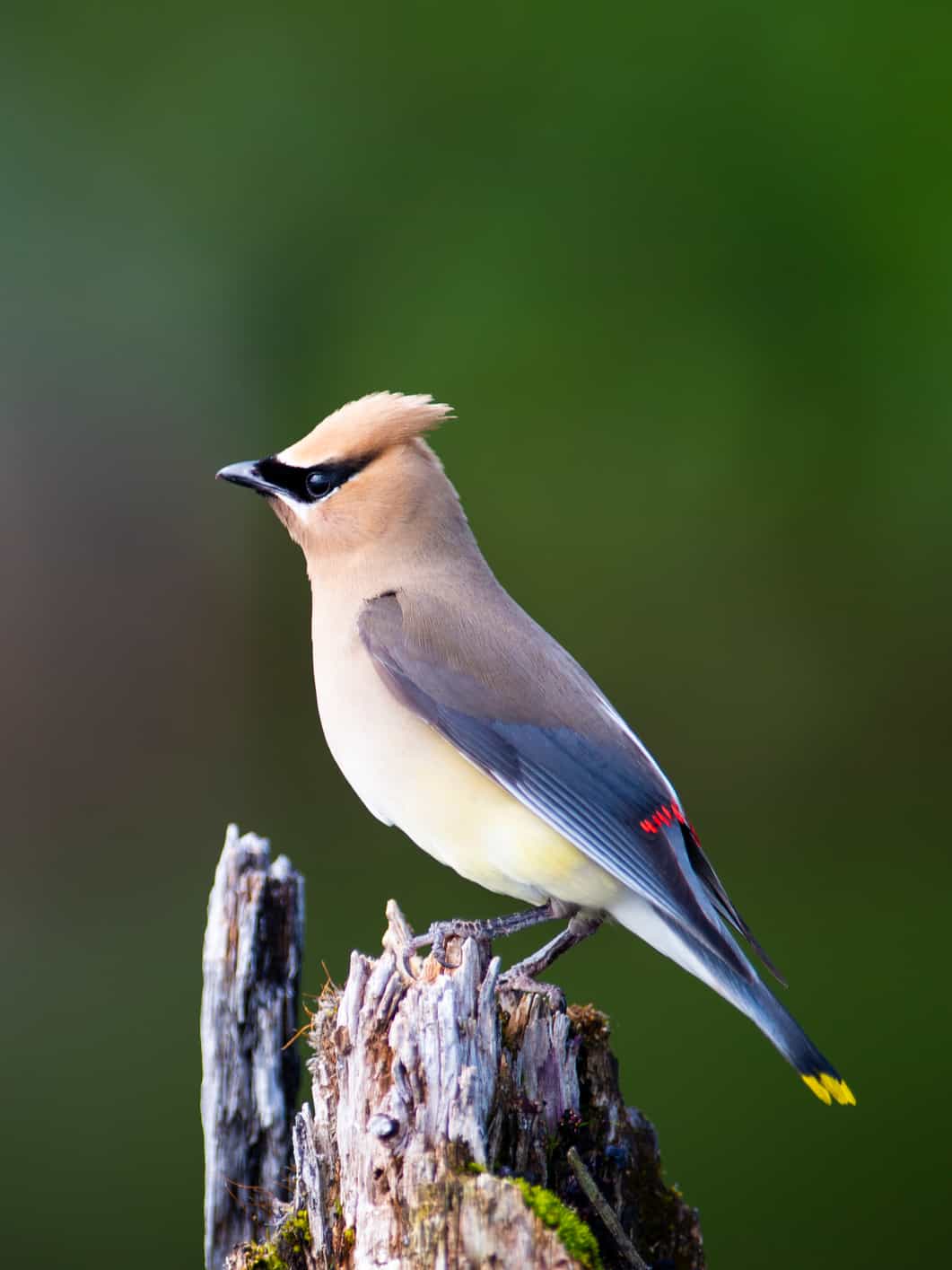
Features a sleek, soft crest on the head and silky gray plumage with a slight pinkish hue
- •
Distinctive black face mask which extends to the throat, bordered by white
- •
The yellow-tipped tail and striking red wax-like tips on the wing feathers set it apart
What does a Bohemian waxwing sound like?
The Bohemian Waxwing's vocalizations are distinctive, characterized by a high-pitched, lisping "seeee" call, which is harsher and more grating than the call of the Cedar Waxwing. The call pattern of this bird falls flat, producing a buzzing sound that alternates between high and trilling whistles. These sounds are eminent during their typical calls and songs which then provide a unique auditory identifier for the species.
Description
If you're looking for berries, your best bet is to follow a Bohemian waxwing. They are winged GPS's for these sweet treats. You could say they love them berry much and eat about 800 to 1,000 a day – or twice their bodyweight. These guys don't really have a song, communicating instead with a series of high-pitched calls.
The Bohemian waxwing can weigh between 34to85grams and be from19to23centimeters tall.
The Bohemian waxwing typically has a lifespan of about 7 to 8 years. This is quite short compared to some related species, such as the Cedar waxwing, which can live up to 16 years. However, maximal recorded age for a Bohemian waxwing is 12.2 years. This bird's lifespan can be affected by factors such as predation and harsh winters.
Did you know?
Most popular questions about Bohemian waxwing
How to recognise a Bohemian waxwing?
General appearance
The Bohemian Waxwing is a crested bird that stands between 7 1/2 -8 1/2 inches (19-22 cm) tall, and is larger and grayer than the Cedar Waxwing. It has chestnut undertail coverts and displays a yellow and white pattern in its wings. Other discernable features include a short, square-tipped, rounded tail and black, gray, red, tan, white, and yellow coloration.
Male vs female
There is little difference visually in the physical appearance between males and females in the Bohemian Waxwing species, as both genders share similar traits in size and coloration. Variations, if any, marginal and not easily discernable in the field.
Juvenile
The juvenile Bohemian Waxwing is characterized by a streaky appearance and has different coloration of undertail coverts when compared to young Cedar waxwings. The size of a juvenile is roughly equivalent to a sparrow or robin, before growing to full adult size.
Often mistaken for
Cedar Waxwing vs Bohemian Waxwing
The Bohemian Waxwing is slightly larger and more robust than the Cedar Waxwing. Bohemians have a distinctive white and yellow wing pattern, while Cedars show white wing bars. The Bohemian sports a gray belly compared to the Cedar’s lighter, buff-colored underparts. Bohemians often exhibit a rufous undertail, whereas Cedars have yellowish undertail coverts. Look for the Bohemian's bright cinnamon face markings that are less pronounced on Cedars. The obvious difference is the Cedar Waxwing's yellow-tipped tail, contrasting with the Bohemian Waxwing's more subtle gray or yellowish hues. Remember, Bohemians often appear in larger flocks, especially in winter.
Breeding and nesting habits of the Bohemian waxwing
Mating behaviors
Bohemian waxwings engage in elaborate courtship displays, including both vocalizations and physical displays such as hopping and fluttering. The male often presents food to the female as part of the courtship ritual.
Nesting details
Bohemian waxwings typically build their nests in coniferous or mixed woods. They prefer to nest in trees, often placing the nest on a horizontal branch away from the trunk. The nest is a well-camouflaged structure made of twigs, grass, and moss, and lined with fine materials like feathers. While they don't commonly nest in gardens, creating a suitable habitat involves planting dense trees and shrubs, providing a supply of berries, which attract these birds.
Eggs and chick-rearing
The female lays 3-7 eggs which are pale blue with dark spots. Both parents participate in incubation and feeding. Incubation lasts about 14-15 days, and the chicks are altricial at birth, requiring feeding and care from both parents for about 14-16 days until they fledge.
What does a Bohemian waxwing like to eat?
Berries
Flowers
Fruits
Insects
Plants
Sap
Scraps
Snails
Spiders
Natural diet
The Bohemian waxwing primarily feeds on insects and berries. In the summer, its diet consists mostly of insects, especially those that fly. As the seasons change, it consumes more berries and fruits which become readily available. During winter, berries become a crucial part of its diet, especially those from mountain-ash and juniper plants. Additionally, the waxwing eats seeds from birch and other trees and drinks tree sap.
Bird feeders
The Bohemian waxwing is typically not a common visitor at bird feeders, as it primarily forages for natural food sources such as berries and insects. However, it might occasionally be attracted to bird feeders offering fruits like apples or other berries, particularly in the winter months when natural food is less abundant.
Offer their favorite feed
To attract Bohemian Waxwings, fill your feeders with their favorite foods. They are particularly fond of fruits and berries. Apples, cherries, and raspberries are much appreciated, especially when they are overripe. Our best recommendation for seeds is Bird Buddy seeds. They are expertly selected for the season and have shown the best results in attracting Waxwings.
Select the right feeder
For Bohemian Waxwings, platform feeders or feeders with wide perches are ideal. These feeding stations allow them enough space to move around comfortably. During winter, ensure that your feeder is sturdy and can withstand snowfall.
Create a bird friendly environment
Waxwings are attracted to places with water sources. If possible, create a birdbath or fountain in your yard. Additionally, planting native trees and shrubs that produce berries can make your yard more attractive to these birds.
Encourage them to stay
A fun trick to encourage them to stay is to play bird songs. Waxwings are known to be social birds with melodious voices. Playing bird songs in your garden may make them feel at home and encourage them to join in for a sing-along!
Where can you find Bohemian waxwings?
Primary habitat
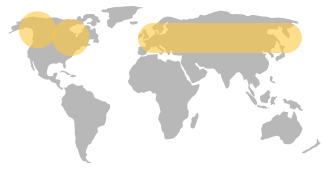
The Bohemian waxwing primarily breeds in far northern forests around open areas, burnt lands or bogs, and in locations with taller trees over a brushy understory.
Additional range
In summer, it inhabits boreal forests and muskegs. During winter, its range expands to more populated areas, including towns with fruiting trees, and in wooded semi-open areas where food is plentiful.
Do they migrate?
The Bohemian Waxwing is a partially migratory bird with movements that are highly variable and unpredictable. While some Bohemian Waxwings remain in their breeding grounds year-round, others undertake irruptive movements, especially in search of food sources like berries. In winter, their migration patterns can vary significantly. During some winters, large numbers of Bohemian Waxwings are observed migrating southward and eastward, extending their range as far as New England in the United States. However, in other years, they can be almost absent from these areas. This inconsistency is similarly observed in regions south of Canada in the western parts of North America. There is no fixed migration route for Bohemian Waxwings, as their movements are primarily dictated by the availability of food rather than a strict migratory path. Key locations during irruptive movements include areas with abundant berry resources, such as rowans and junipers. Overall, the migration of Bohemian Waxwings is characterized by its erratic nature, making it difficult to predict when and where large flocks will appear each year.
What is the role of Bohemian waxwings in nature and how to protect them?
Conservation status
The Bohemian waxwing's breeding population is challenging to census, but recent increases in their numbers in some southerly winter areas suggest that the species is not currently endangered. It is generally considered common rather than vulnerable or endangered. There are no significant conservation efforts specifically targeting this species, as it faces minimal immediate threats. However, monitoring is essential to ensure habitat preservation and to address any potential future challenges related to climate change or habitat loss that could impact their migratory and wintering patterns.
Ecological role of Bohemian waxwings
Its role in the ecosystem
The Bohemian waxwing plays a significant ecological role, primarily in pest control and seed dispersal. Its diet predominantly consists of insects and berries, depending on the season. During summer, it largely feeds on flying insects, thus aiding in controlling insect pests. In the colder months, it turns to consume more berries, fruits, and seeds from trees like birch, mountain ash, and junipers, impacting seed dispersal. As it feasts on ripe berries, the seeds are excreted in different locations, aiding in the propagation of these plants. Additionally, consuming oozing tree sap can also help control excess sap flow, contributing to the overall health of trees. The fact that it usually forages in flocks amplifies these ecological influences. Overall, the Bohemian waxwing is a valuable part of its ecosystem.
How to help protect Bohemian waxwings
Preservation tips
Habitat preservation
Protect and conserve the Bohemian waxwing's natural habitats which mainly consist of open woodlands, boreal forests, and watersides with abundant berry-producing trees and shrubs. Prevent deforestation and urbanization in these areas. Promote the planting of native berry trees like juniper, mountain ash, and hawthorn, which provide the primary food source for the species.
Community science initiatives
Encourage involvement in citizen science projects such as the 'Christmas Bird Count' and 'Project FeederWatch' that record sightings of waxwings. Such data can assist scientists in tracking changes in population trends and distribution. Educate local communities about the importance of these birds and how to identify them. Advocate responsible birdwatching practices that minimize disturbances to the species.