
Yellow-Breasted Chat
Yellow-Breasted Chat
Icteria virens


Quick Identification guide
Quick Identification guide
- •
Identified by its bright yellow breast and olive-green back, creating a vibrant contrast
- •
Features a thick, slightly curved beak useful for foraging
- •
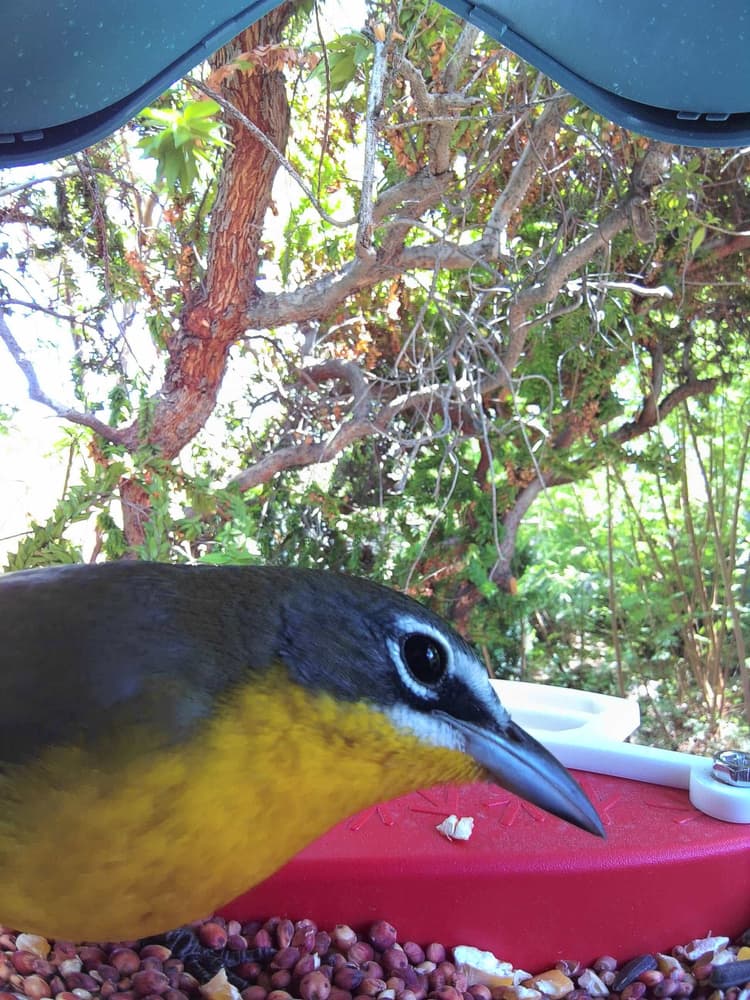
Shows a long tail and white spectacles around the eyes, adding distinct facial markings
What does a yellow-breasted chat sound like?
The Yellow-breasted Chat is known for its varied vocalizations comprised of croaks, whistles, and short repeated phrases. Its call pattern is flat, presenting in forms like chirps, chips, rattles, and whistles. These birds often sing at night, and sometimes perform a musical display flight where they flop awkwardly up and down with their legs dangling, while still producing their melodious tunes.


Description
Did you know male yellow-breasted chats are mostly monogamous, possibly because females are known to be pretty aggressive and possessive. Sounds like they know what's good for 'em! Brown-headed cowbirds often lay an egg in their nests. How they react depends on the individual. Some will desert the nest upon finding out, while others stick around and raise the chick as their own.
The yellow-breasted chat can weigh between 21.5to36grams and be from18to19centimeters tall.
The yellow-breasted chat typically lives up to seven years. Compared to other related species in the New World warbler family, it has a relatively shorter lifespan. For instance, the black-and-white warbler can live up to 11 years, while the ovenbird can live up to 11.5 years.
Did you know?
Most popular questions about yellow-breasted chat
How to recognise a yellow-breasted chat?
General appearance
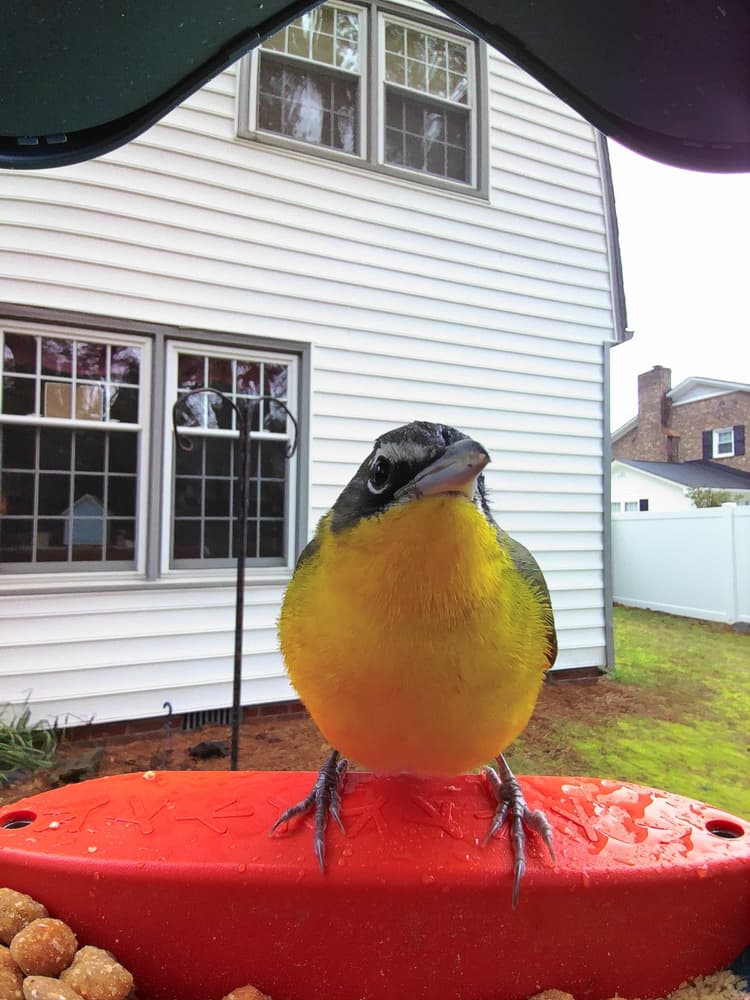
A yellow-breasted chat is characterized by its thick bill, long tail, striking yellow throat and breast that can sometimes look orange. This contrasts against its white belly and olive back. It is also noticeable for the sharp white 'spectacles' on its darker face. The bird is about the size of a robin or a sparrow, and has black, brown, gray, white, and yellow colors. Its wings and tail are rounded, with the tail sometimes appearing square-tipped.
Male vs female
Sexual dimorphism where males and females significantly differ in appearance is not particularly evident among yellow-breasted chats. Males and females are similar in size and coloration, although males often have a slightly more vibrant yellow breast and throat than females.
Juvenile
The juvenile yellow-breasted chat resembles adults in physical characteristics but are usually less vibrant in color. They may have a lighter hue of yellow on the throat and breast, and the notable white 'spectacles' are often less pronounced. As young birds mature, their colors begin to intensify.
Often mistaken for
Common Yellowthroat vs Yellow-Breasted Chat
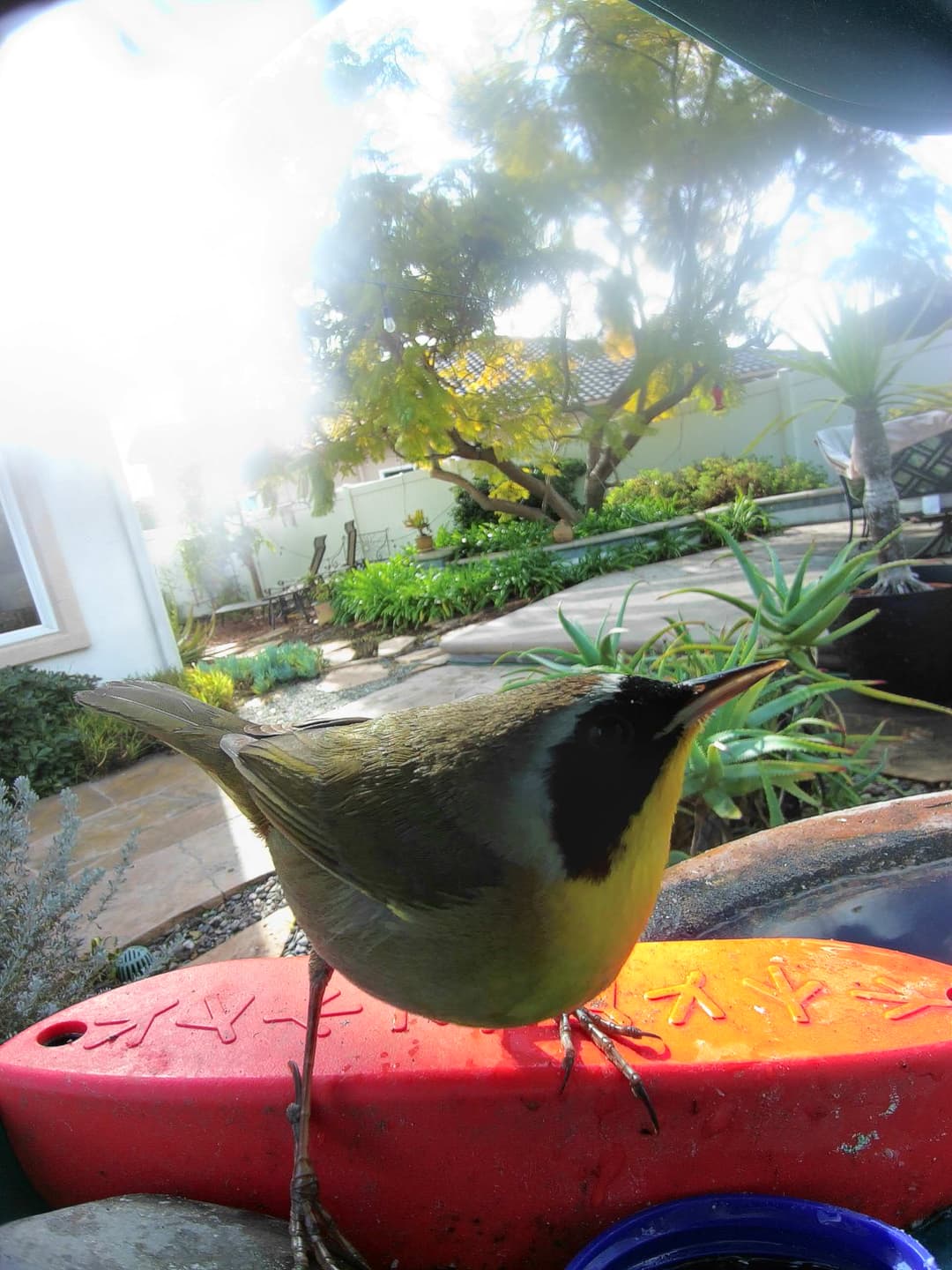
While both the Yellow-Breasted Chat and the Common Yellowthroat have yellow underparts, the Chat is larger with a distinctive white eyering and a thicker bill. The Chat sports a more olive-green back compared to the Yellowthroat’s browner hue. Chats often display a combination of whistles, squawks, and chattering songs, unlike the Common Yellowthroat's simpler 'witchety' song. Observe behavior; Chats tend to be more secretive, frequently lurking in dense thickets, while Yellowthroats are often seen flitting in marshy areas.
Breeding and nesting habits of the yellow-breasted chat
Mating behaviors
During courtship, the male yellow-breasted chat displays to the female by pointing its bill upwards and swaying from side to side. In its flight song display, the male ascends while singing, hovers, then descends slowly with wings flapping over the back and legs dangling loosely.
Nesting details
The yellow-breasted chat occasionally nests in loose colonies. Nests are placed 1-8 feet above the ground and are well concealed in dense shrubs or tangled vines. The nest is a large open cup, constructed by the female, with an outer base of dead leaves, straw, and weeds, and a tightly woven inner nest of vine bark lined with fine weed stems and grass.
Eggs and chick-rearing
The female is responsible for building the nest and potentially incubating the eggs once they are laid. While specific details on chick rearing are not provided, the choice of dense and concealed nesting locations suggests a focus on protection from predators.
What does a yellow-breasted chat like to eat?
Berries
Flowers
Fruits
Insects
Spiders
Natural diet
The yellow-breasted chat feeds on a diverse array of insects, including moths, beetles, bugs, ants, bees, wasps, mayflies, grasshoppers, katydids, caterpillars, praying mantises, and spiders. Berries and wild fruits form up to half or more of its diet, especially in the fall. These include blackberries, elderberries, wild grapes, and other similar fruits.
Bird feeders
In regions where yellow-breasted chats winter, particularly in the Northeast, they are known to visit bird feeders. At these feeders, they will consume a range of non-natural items, such as suet and peanut butter, which are not typically part of their diet in the wild.
Attracting yellow-breasted chats to your yard
Draw these delightful singers into your yard by providing their preferred food, setting up suitable feeders, and creating an inviting peacock habitat. As these birds love insects and berries, fill your feeders with Bird Buddy seeds. These are expertly chosen for the season, boosting your chances of attracting these charming birds. Don't forget to add some fruit to the feeders for an extra treat.
Fun tricks to tempt yellow-breasted chats
Once your bird feeders are set up clothed with Bird Buddy seeds, make sure your yard is a safe and inviting environment. These birds love dense shrubbery where they can hide and nest. Consider setting up a bird bath where they can splash and play. Use soft playing bird sounds for attracting them, this often triggers curiosity and they might visit your yard for a sing-along!
Where can you find yellow-breasted chats?

Primary habitat
The yellow-breasted chat primarily occupies very dense scrub, briary tangles, and willow thickets, often found alongside streams, swamps, or ponds edges.
Additional range
Its habitat extends to dry, overgrown pastures and upland thickets along woodland margins. In tropical winter, it is found in lowland open scrub and woodland edges.
Do they migrate?
The yellow-breasted chat is a migratory bird. Most individuals of this species leave their breeding territories in the fall to spend the winter in tropical regions. Typically, these birds migrate to Central America, including countries like Mexico, Belize, and Honduras. However, during the fall migration, many yellow-breasted chats are observed along the northeastern coast of North America. This suggests a migratory route that may involve traveling down the eastern side of the continent. Interestingly, some yellow-breasted chats choose to overwinter along this northeastern route, even reaching areas as far north as New England. This can be attributed to mild winters or the availability of suitable habitat and food sources in these regions. The timing of their migration typically aligns with the changing seasons, as they move south in the fall and return to their breeding grounds during the spring. By spring, most have returned to their breeding sites across the United States and southern Canada. Key locations for these migratory activities include coastal areas and inland habitats that provide ample cover and food resources, such as dense shrubs and wooded areas.
What is the role of yellow-breasted chats in nature and how to protect them?
Conservation status
The yellow-breasted chat is generally considered stable, though it has experienced declines in parts of the Southwest and other regions. Historically, its population may have increased in the East due to forest clearing, which created more suitable brushy habitats. The species is not classified as endangered or vulnerable. Key threats include habitat loss and degradation, especially due to urbanization and agricultural expansion. Conservation efforts focus on preserving and restoring suitable habitats, particularly in areas where declines have been noted, to ensure the species maintains a stable population across its range.
Ecological role of yellow-breasted chats
Its role in the ecosystem
The Yellow-breasted Chat plays two key roles in maintaining ecological balance in its habitat. Giantally, it contributes to pest control by consuming various kinds of insects, such as moths, beetles, ants, bees, wasps, and caterpillars. This consumption helps keep insect populations in check, thereby reducing possible harm that these pests could inflict on plants or other species in the ecosystem. Secondly, the bird helps in the dispersion of seeds by consuming a large portion of its diet in berries and wild fruits. As the bird travels, the seeds from these fruits are effectively dispersed in the environment, contributing to the growth and spread of various types of vegetation. It also attracts other creatures to the ecosystem due to its diet. An additional role the Yellow-breasted Chat plays is acting as prey for larger predators, further signalling its integrated place within the food chain.
How to help protect yellow-breasted chats
Preservation tips
Habitat preservation strategies
Encourage local landowners to create and maintain suitable habitats for the yellow-breasted chat. This includes managing young forests, maintaining shrubby areas and allowing for a mix of open and densely vegetated spaces. Restrict deforestation and advocate for sustainable land use, particularly in areas identified as breeding grounds. Support organizations working on habitat protection and restoration efforts.
Community science initiatives
Engage the local community in conservation efforts by conducting citizen science projects to monitor chat populations. Regular bird counts can help track numbers and distribution. Promote awareness about the yellow-breasted chat, its ecological role, and threats it faces. Organize educational workshops or bird-watching events to involve the public. Document sightings on bird reporting websites to contribute to larger conservation databases.