
Clark’s Nutcracker
Clark’s Nutcracker
Also known as: Clark's Crow, Woodpecker Crow
Nucifraga columbiana


Quick Identification guide
Quick Identification guide
Male
- •
medium-sized bird with a stocky build
- •
Primarily light gray plumage with black wings
- •
Distinctive long, pointed beak perfect for prying seeds
Female
- •
medium-sized bird similar in shape to male
- •
Shares the light gray plumage with black wings
- •
Same long, pointed beak for seed extraction
What does a Clark's nutcracker sound like?
The Clark's nutcracker produces a variety of vocalizations. Its typical calls include a guttural 'kraaaa', with varying patterns of falling, flat, and rising tones. The call types are diverse ranging from a simple chirp or chip to a more complex rattle. It also can give out a raucous scream, indicating its noticeable presence. These calls and songs are a distinct aspect of its communication repertoire.


Description
Clark's nutcrackers have a special pouch under their tongue that they use to carry pine seeds. It can hold anywhere between 30 and 150 seeds. They store them for later and can remember where they stored most of them thanks to their amazing memory. The collective noun for a group of nutcrackers is a jar!
The Clark's nutcracker can weigh between 106to161grams and be from27to30.1centimeters tall.
The Clark’s nutcracker, a member of the corvidae family, typically lives up to 17 years in the wild, similar to other corvids such as the American Crow but less than the Common Raven. These lifespans, however, can vary significantly based on factors such as predation and disease.
Did you know?
Most popular questions about Clark's nutcracker
How to recognise a Clark's nutcracker?
General appearance
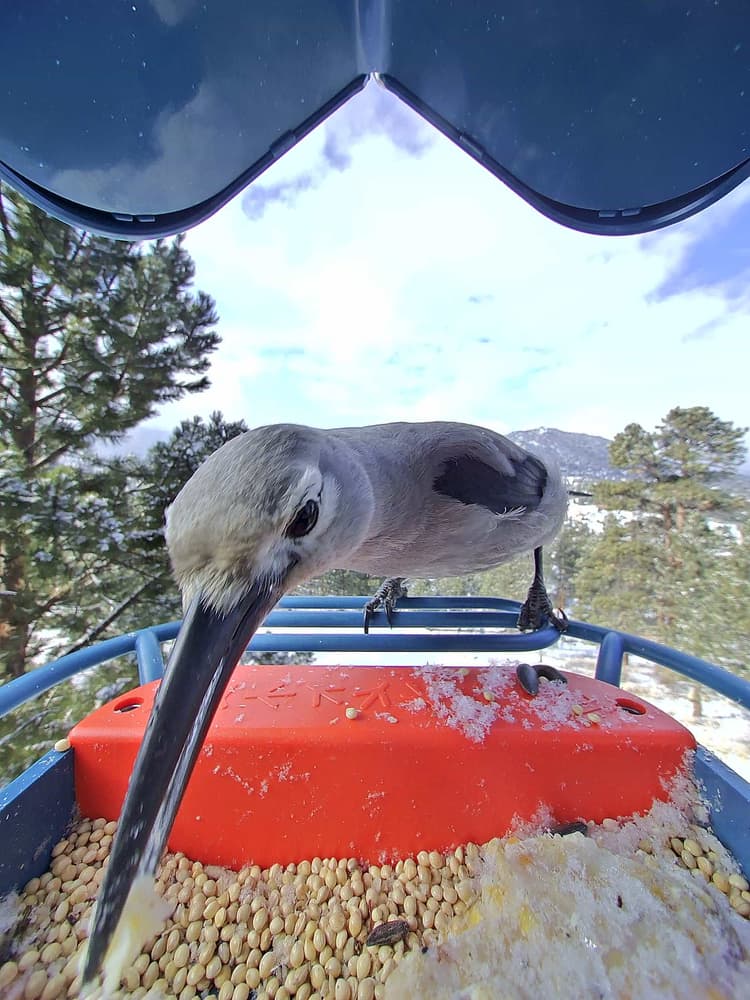
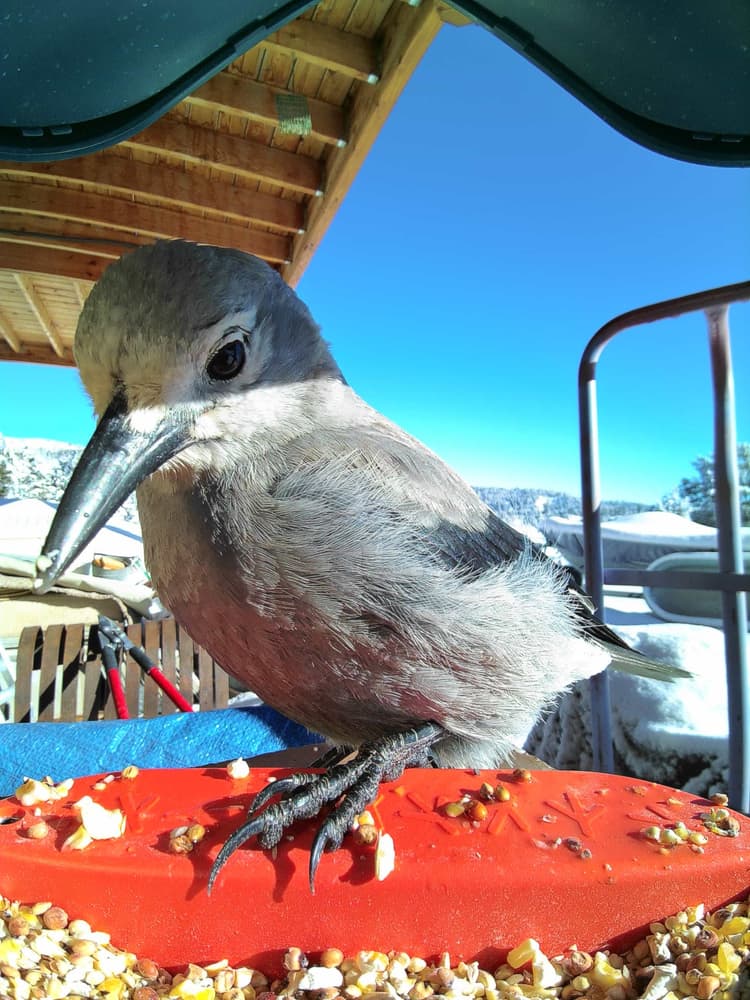
The Clark’s nutcracker is a large bird around 12-13 inches (30-33 cm) in size, roughly the size of a crow, with a predominant pale gray coloration. It has a distinct long, finger-rounded wings shape and square-tipped, rounded tail. Noticeable in its appearance are the large white patches amid its black wings and tail, especially evident during flight. Its bill is spike-pointed, a trait that is more pronounced than the smaller bill of the Gray Jay.
Male vs female
The physical traits such as size, coloration, and distinctive marks of the Clark’s nutcracker do not significantly differ between males and females. Both sexes share similar features, which make it difficult to distinguish them based on physical appearance alone.
Juvenile
Juvenile Clark’s nutcrackers resemble adults but are generally duller. Their feathers, while also gray, tend to be more muted, lacking the stark contrast between the white patches and black wings and tail seen in adults. Their bills may also be less pointed as compared to the spiked bill of mature nutcrackers.
Often mistaken for
Canada Jay vs Clark’s Nutcracker
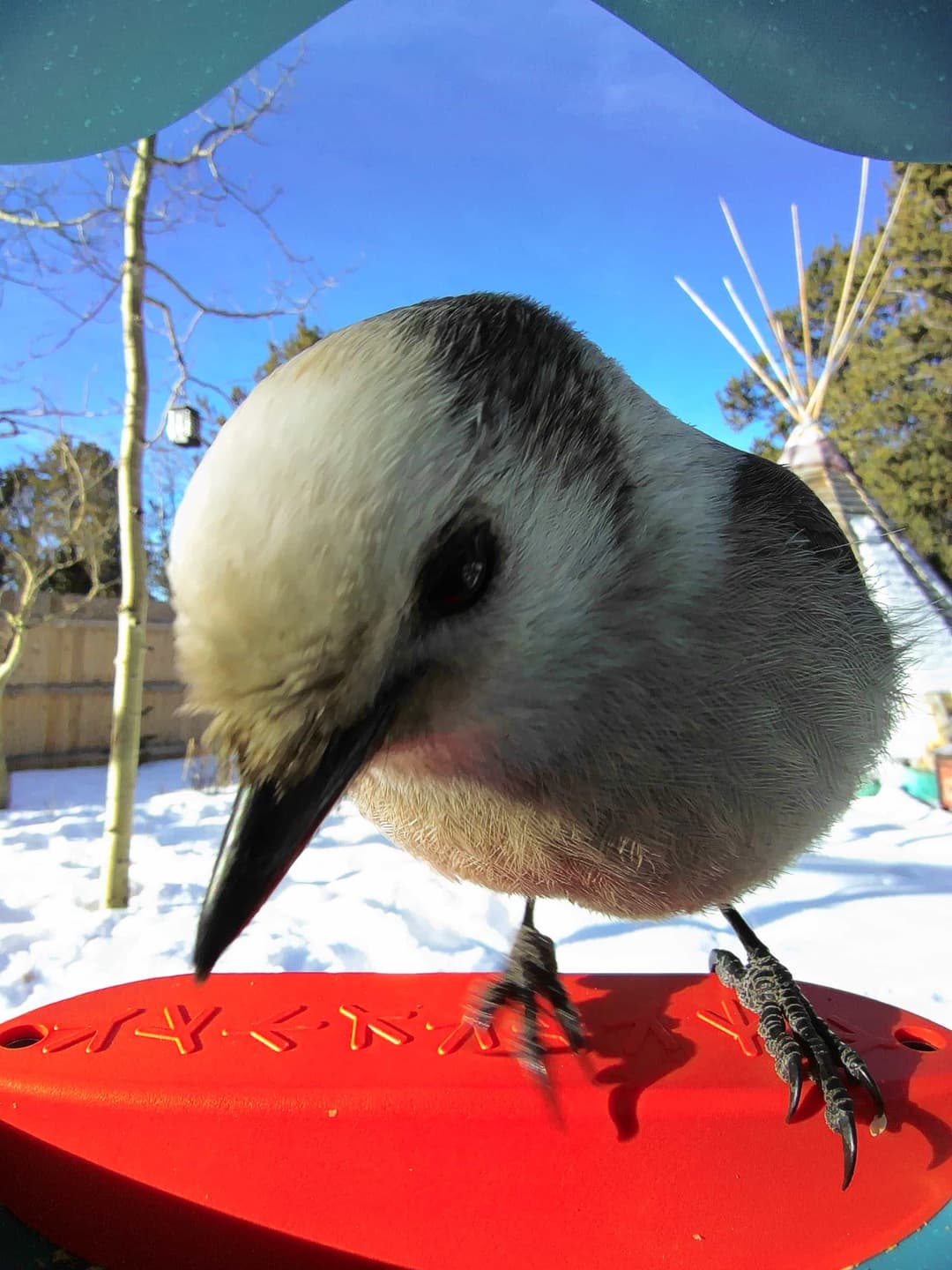
Clark’s Nutcracker is larger and more robust than the Canada Jay, with a prominent long, sharp bill compared to the shorter bill of the Canada Jay. The Nutcracker exhibits a distinct black and white wing pattern while Canada Jay has softer, pale gray plumage without stark contrasts. Look for the Nutcracker's white underparts and gray body, contrasting with the more uniform gray of the Canada Jay.
Breeding and nesting habits of the Clark's nutcracker
Mating behaviors
Clark's nutcrackers engage in courtship starting in late winter, even when territories are snow-covered. Males often follow females during long flights as part of their courtship ritual.
Nesting details
Nests are built in coniferous trees, typically on horizontal limbs away from the trunk, at heights of 8-40 feet above the ground. Both sexes participate in building a large, deep nest using twigs and bark fibers, with a cup of grass, bark strips, and pine needles for support.
Eggs and chick-rearing
After the nest is constructed, females lay eggs which both parents help incubate and later rear the chicks. Practical advice for attracting Clark's nutcrackers to gardens is not applicable as they do not typically nest in such environments.
What does a Clark's nutcracker like to eat?
Bird eggs
Birds
Carrion
Fruits
Insects
Nuts
Seeds
Natural diet
The Clark’s nutcracker is an omnivore, with a significant portion of its diet consisting of pine seeds. Its diet is quite diverse, also including other types of seeds, nuts, and various berries. This bird additionally consumes insects and snails. Clark’s nutcrackers have been known to eat the eggs and young of other birds and may even feed on carrion.
Bird feeders
While their natural diet is diverse, at bird feeders, Clark’s nutcrackers are likely to consume seeds and nuts common to these environments. They may be particularly attracted to feeders offering peanuts, sunflower seeds, and suet, which provide high-energy nutrients similar to their natural food sources.
Choosing the right feeder
Clark's nutcracker birds are particularly fond of platform feeders. These feeders have large flat surfaces that allow the birds to easily access and pick up seeds. Just ensure your feeder is sturdy enough to handle the weight of a Clark's nutcracker as they are slightly larger than most songbirds. For better results, position your feeder in a quiet, safe spot, preferably close to trees where they can perch and feel secure.
Providing the perfect snacks
Clark's nutcrackers have a strong preference for pine seeds which are their natural food source. However, they also love large, oily seeds such as sunflower seeds. We highly recommend Bird Buddy seeds. These seeds are chosen by experts for each season and have proved to yield the best results in attracting these birds to feeders.
Using fun tricks to encourage visits
Clark's nutcrackers are curious birds, and their curiosity can be used to your advantage. Consider hanging shiny objects around your yard or feeder as they are attracted to shiny things. You can also set up a bird bath near the feeder to provide a source of water for them. As an added bonus, Clark's nutcrackers are known for their raucous calls, so you might be treated to a bird 'sing-along' once they're comfortable with the environment.
Where can you find Clark’s nutcrackers?

Primary habitat
The Clark’s nutcracker generally prefers high-elevation mountain areas with coniferous forests of pine, spruce, or Douglas fir.
Additional range
Alternatively, the bird can inhabit lower-elevation pine or pinyon-juniper woods, particularly during ample cone crop seasons. It can roam above treeline in summer and relocate to lower woods in fall.
Do they migrate?
The Clark’s nutcracker is primarily a permanent resident in its habitat, but its movements are complex and variable. While it does not undertake long-distance migrations like some other bird species, it does exhibit seasonal movement patterns that are influenced by food availability. During the fall, particularly in years when food crops in the mountains are inadequate, Clark’s nutcrackers may descend to lower elevations and even venture into lowland areas in search of sustenance. This movement is not a strict migration in the traditional sense but rather a shift in elevation to optimize resource availability. The timing of these movements typically coincides with the autumn season when food scarcity due to poor crops prompts the nutcrackers to alter their location. Key locations for these seasonal movements include mountain regions where they reside year-round, transitioning to adjoining lower elevation forests and plains as needed. This movement allows them to access different food sources such as seeds and nuts, essential for their survival during the winter months. Overall, Clark’s nutcrackers demonstrate adaptability in their movement patterns rather than a fixed migratory route.
What is the role of Clark’s nutcrackers in nature and how to protect them?
Conservation status
The conservation status of the Clark's nutcracker is not clearly defined due to the lack of comprehensive data on its population trends. However, it is considered potentially vulnerable, mainly due to its reliance on mountaintop habitats, which are at risk from climate change. Significant threats include habitat alteration and climate-induced shifts in its environment. There are no specific large-scale conservation efforts dedicated solely to this species, but protecting its montane habitats is crucial. Ensuring healthy ecosystems where it resides can help mitigate climate-related impacts.
Ecological role of Clark’s nutcrackers
Its role in the ecosystem
The Clark’s nutcracker is a significant ecological player in its ecosystem. As an omnivore, it helps regulate pest populations, preying on insects and their larvae as well as snails. It also consumes eggs and young of other bird species, thereby balancing other bird populations. More significantly though is its role in seed dispersal. The bird gathers and stores large quantities of pine seeds in the late summer and fall, often numbering in the tens of thousands, which it buries in the soil of exposed slopes for winter consumption. This behavior aids in the propagation of pine trees as some of the seeds are inevitably forgotten or not retrieved, allowing new trees to germinate. Importantly, this species' ability to remember the locations of its food caches is also a testament to its remarkable adaptation to its environment. Hence, the Clark’s nutcracker provides a crucial service to its ecosystem through its feeding behavior.
How to help protect Clark’s nutcrackers
Preservation tips
Habitat preservation strategies
Preserving and restoring the prime habitats of Clark's nutcracker, such as pine forests, is crucial. This includes enforcing strict logging rules, reviving damaged ecologies through reforestation, and limiting human intrusion. Also, protect existing whitebark pine trees which are the nutcracker's primary food source, by controlling diseases and pests, and instituting wildlife fire management strategies.
Community science initiatives
Engage local communities in citizen science initiatives to monitor and track Clark's nutcracker populations and habitats. Encourage schools, clubs, and individuals to participate in bird counts and submit observations to databases like eBird. Workshops can be held to teach locals how to identify Clark's nutcracker and their behaviors. Importantly, raise local awareness about the nutcracker's ecological importance and their declining situation.