Eastern Phoebe or Black Phoebe?
Here's how to tell the difference

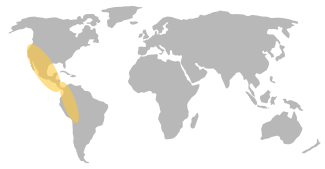


Eastern Phoebe


Black Phoebe
Eastern Phoebe
Sayornis phoebe
General appearance
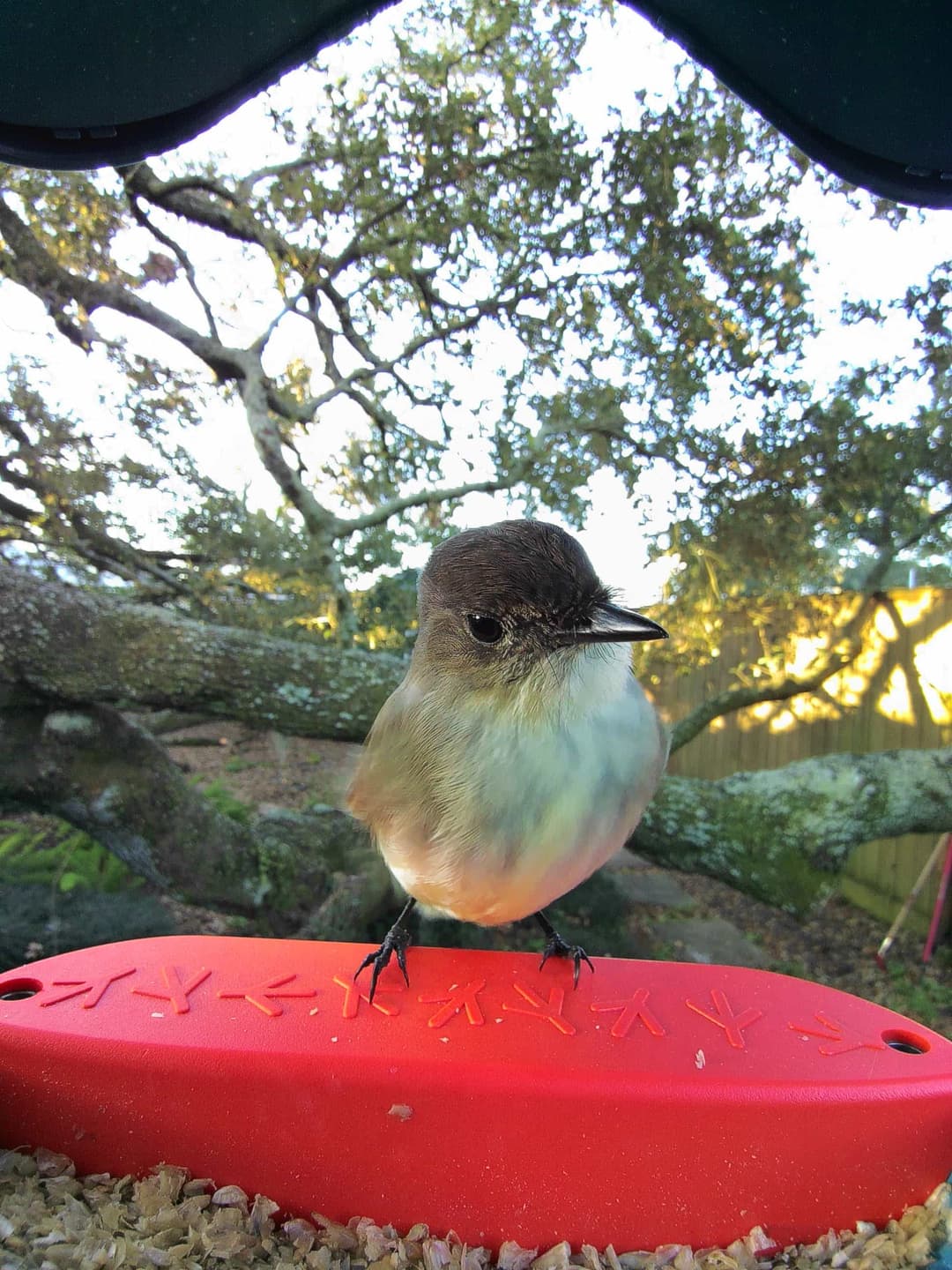
The eastern phoebe is a medium-sized bird with a length of around 18 cm. It resembles the size of a Robin or Sparrow. It showcases a sharp contrast between its whitish throat and sooty brown head, appearing gray-brown above and off-white below with no noticeable marks. The bird has a rounded wing shape with a notched, rounded, or square-tipped tail.
Male vs female
Both male and female eastern phoebes have identical physical attributes and coloration, making them difficult to distinguish. They both share a sooty brown head, off-white underside, and gray-brown upper body.
Juvenile
Juvenile eastern phoebes look similar to their adult counterparts but are often seen with faint wing-bars. In the fall, their plumage has a yellow wash below.
Size
5.5 - 6.7 in/0.6 - 0.7 oz
There's more to learn about Eastern Phoebe
View full detailsBlack Phoebe
Sayornis nigricans
General appearance
The Black Phoebe is a distinctive bird of about 6-7 inches (15-18 cm) in size, similar to a Robin or Sparrow. It has a slim shape and an upright posture. The coloration is primarily dark charcoal gray or black, notably blacker on the head. Its belly is starkly white, with wings that have a rounded shape. The tail frequently dips downwards and upwards when perched and comes in three forms - notched, rounded, or square-tipped.
Male vs female
Differences between males and females of the Black Phoebe species are not explicitly identifiable from the information available, indicating that they may likely have a similar appearance across genders.
Juvenile
Juvenile Black Phoebes have a slightly different color pattern in the summer season. They exhibit rusty edges on the feathers on their wings and back, which is different from adult black phoebes. This variation aids in distinguishing younger Black Phoebes from their adult counterparts in the wild.
Size
5.9 - 7.1 in/0.5 - 0.8 oz
There's more to learn about Black Phoebe
View full detailsHow to tell the Eastern Phoebe from the Black Phoebe
Visual differences
The Eastern Phoebe is about 6.7 inches long and showcases a gray-brown top with a whitish throat and off-white underside. The Black Phoebe is similar in size, about 6-7 inches long, but is primarily dark charcoal gray to black, with a starkly white belly. The Black Phoebe's head is notably darker than the Eastern Phoebe's sooty brown head. Both species exhibit rounded wings and notched or square-tipped tails, but the Black Phoebe's tail frequently dips in motion. Juveniles of both have distinct feather markings.
Key differences and behavior
The Eastern Phoebe and Black Phoebe both belong to the Sayornis genus, but they exhibit distinct behavioral and habitat preferences. Eastern Phoebes frequent woodland edges and streamsides, often building their nests on man-made structures, whereas Black Phoebes are closely tied to water sources, such as streams and irrigation ditches. Both species feed primarily on insects, but Black Phoebes also occasionally consume small fish. In terms of breeding behavior, Eastern Phoebes are unique in sometimes maintaining dual nests, with males helping to feed young in both. Alternatively, Black Phoebe males engage in elaborate aerial displays to court females, who ultimately construct the nests from mud and plant fibers. Interestingly, Eastern Phoebes sing without needing to learn from others, while Black Phoebes utilize songs and hoovers during mating rituals. Neither species is attracted to bird feeders, favoring natural hunting for their insect-based diets.
Still not sure? Here are more lookalikes!
Eastern Phoebe vs [Select a bird]

[Select a bird]
Pick a bird to compare
Black Phoebe vs [Select a bird]

[Select a bird]
Pick a bird to compare