Scissor-Tailed Flycatcher or Eastern Kingbird?
Here's how to tell the difference



Scissor-Tailed Flycatcher


Eastern Kingbird
Scissor-Tailed Flycatcher
Tyrannus forficatus
Also known as: Texas Bird-of-Paradise, Swallow-Tailed Flycatcher
General appearance
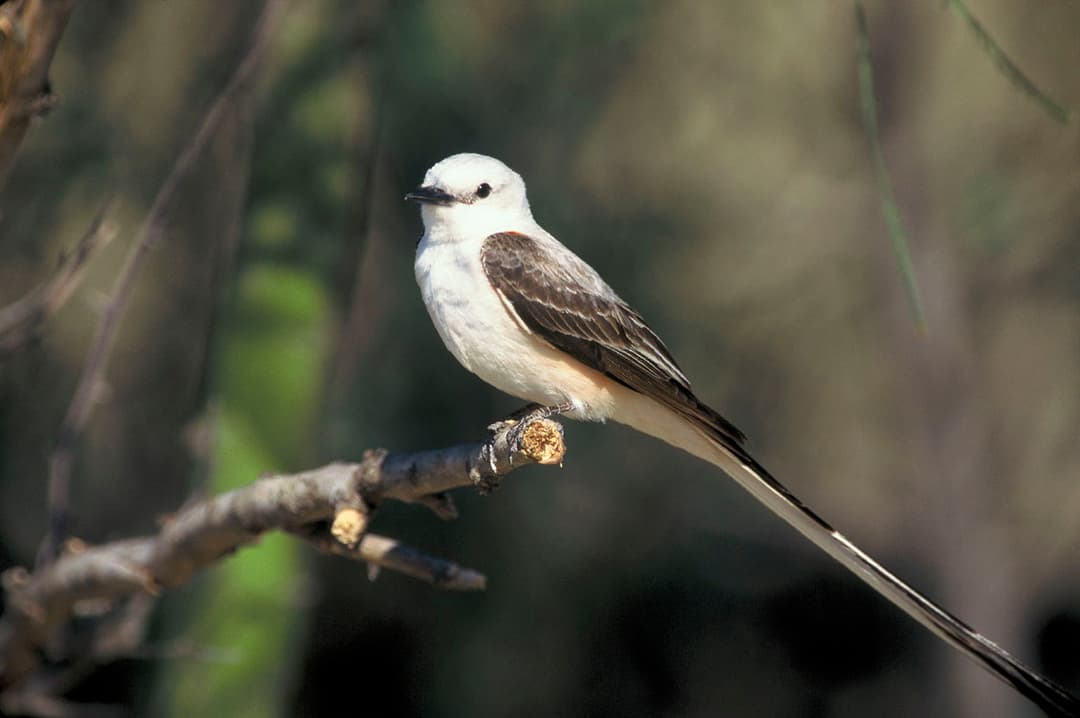
The scissor-tailed flycatcher is a pale bird measuring around 14 inches (36 cm). Its overall coloration is grayish, with dusky wings and vibrant streaks of red on the sides and under the wings. Desired for its remarkable tail, it has long, streaming black and white fork-shaped tail feathers that take on a scissor-like appearance in flight. The bird exhibits pointed wing shapes, hence the size is about the same as a crow.
Male vs female
Sexual dimorphism in the scissor-tailed flycatcher is evident in the length of the tail. Males possess a slightly lengthier tail than that of the females, furthering their distinguishing forked tail characteristic. However, both genders share similar coloration and size.
Juvenile
Juvenile scissor-tailed flycatchers have shorter tails than adults, and their coloration is somewhat paler. They closely resemble the Western Kingbird fledglings in appearance. Through maturation, they grow to attain the adult resemblance.
Size
8.3 - 14.6 in/1.3 - 2.0 oz
There's more to learn about Scissor-Tailed Flycatcher
View full detailsEastern Kingbird
Tyrannus tyrannus
General appearance
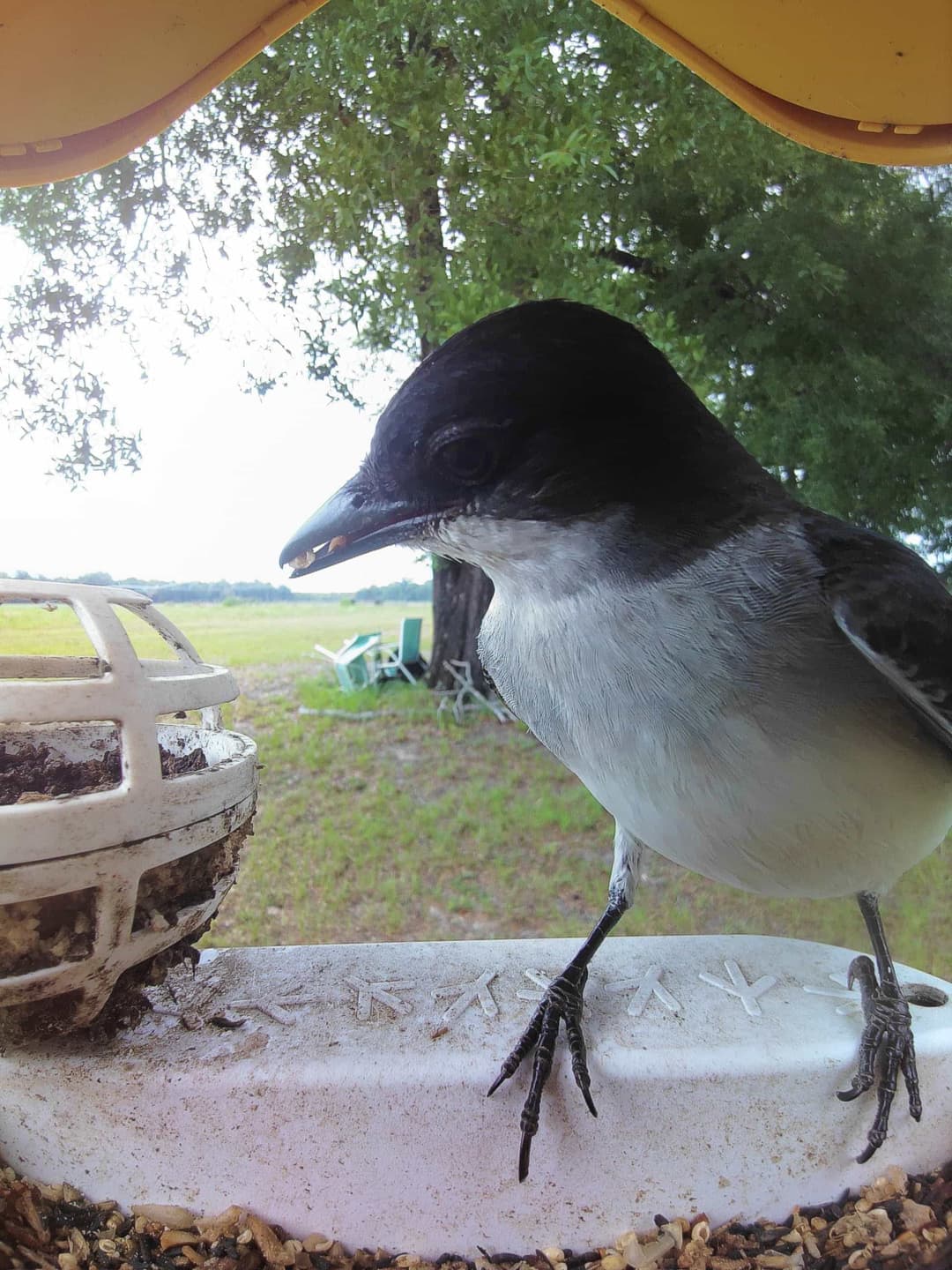
The eastern kingbird is a bird of medium size, similar to a Robin, with a length of 8 to 9 inches or 20 to 23 centimeters. Its coloration is blackish on the top and white underneath, with a wash of gray across the chest providing contrast. The most distinct characteristic is the broad white band at the tip of its otherwise black tail. Additionally, it has a pointed wing shape and a tail rounded or square-tipped.
Male vs female
There is not much sexual dimorphism in the Eastern Kingbird species. Both genders display same physical characteristics including the diagnostic white tail band and the hidden strip of red feathers on the crown. Identification through gender based differentiation is therefore difficult.
Juvenile
Similar to adults, Juvenile Eastern Kingbirds also present similar coloration. However, their colors may not be as vibrant, and the white bands on their tails could be less defined.
Size
7.7 - 9.1 in/1.1 - 1.9 oz
There's more to learn about Eastern Kingbird
View full detailsHow to tell the Scissor-Tailed Flycatcher from the Eastern Kingbird
Visual differences
The Scissor-Tailed Flycatcher is larger (14-16 inches) than the Eastern Kingbird (8-9 inches). The Flycatcher features a strikingly long, forked tail reaching half its body length with black and white feathers, whereas the Kingbird displays a shorter, square-tipped tail with a distinct white band. The Flycatcher’s plumage is pale gray with red accents on the flanks and underwings, while the Kingbird is blackish above, white below with a gray chest. Both have pointed wings, but the Flycatcher's dramatic tail and vibrant accents are key distinguishing features.
Key differences and behavior
The Scissor-Tailed Flycatcher and Eastern Kingbird exhibit distinct behaviors. The Scissor-Tailed Flycatcher is known for its remarkable aerial maneuvers to catch insects, often forming large migratory roosts. They prefer open country with scattered trees for nesting and exhibit dynamic courtship displays. Conversely, Eastern Kingbirds are highly territorial, fearlessly attacking larger birds. They inhabit open areas with trees, aggressively defending their nesting sites. Eastern Kingbirds perform acrobatic displays during courtship, sometimes revealing a hidden red crown patch. Both primarily consume insects and fruits, but the Scissor-Tailed Flycatcher specializes in aerial hunting, while Eastern Kingbirds exhibit robust territorial aggression.
Still not sure? Here are more lookalikes!
Scissor-Tailed Flycatcher vs [Select a bird]

[Select a bird]
Pick a bird to compare
Eastern Kingbird vs [Select a bird]
[Select a bird]
Pick a bird to compare