
Winter Wren
Winter Wren
Troglodytes hiemalis
Quick Identification guide
Quick Identification guide
- •
Features a compact, strong body with rich brown plumage, heavily streaked with darker brown
- •
Exhibits a short tail often held upright, contributing to its distinct posture
- •
Possesses a thin, slightly curved beak, suitable for foraging in tight spaces
What does a winter wren sound like?
The Winter Wren's vocalizations are intricate, consisting of a high-pitched, rapid, and diverse series of musical trills and chatters. Its calls often possess a complex, flat, undulating pattern, sounding like an explosive "kit!" or "kit-kit!" Its different call types include a buzz, chirp or chip, a flute-like sound, an expression similar to "hi," a trill, and even a whistle. The vocal range and variety of the Winter Wren are impressively diverse, making its song not just a call, but a complex melody.
Description
Did you know that winter wrens weren't distinguished from the Eurasian and Pacific wren until 2010? They were all thought to be the same species. Turns out, there are a lot of wrens out there! These guys may be small but, boy, do they have some pipes on them! Their song is, if we take into account their respective sizes, ten times more powerful than a rooster's. That's not their only skill; when wooing their mate, males will build multiple nests and let her decide which one she likes best!
The winter wren can weigh between 8.5to12grams and be from7.9to11.9centimeters tall.
The winter wren typically lives to around seven years old. Compared to related species, this lifespan is fairly standard. The Carolina wren can live up to six years, while the marsh wren has a lifespan of about nine years. Age-related variations can occur depending on factors such as disease, predation, and habitat.
Did you know?
Most popular questions about winter wren
How to recognise a winter wren?
General appearance
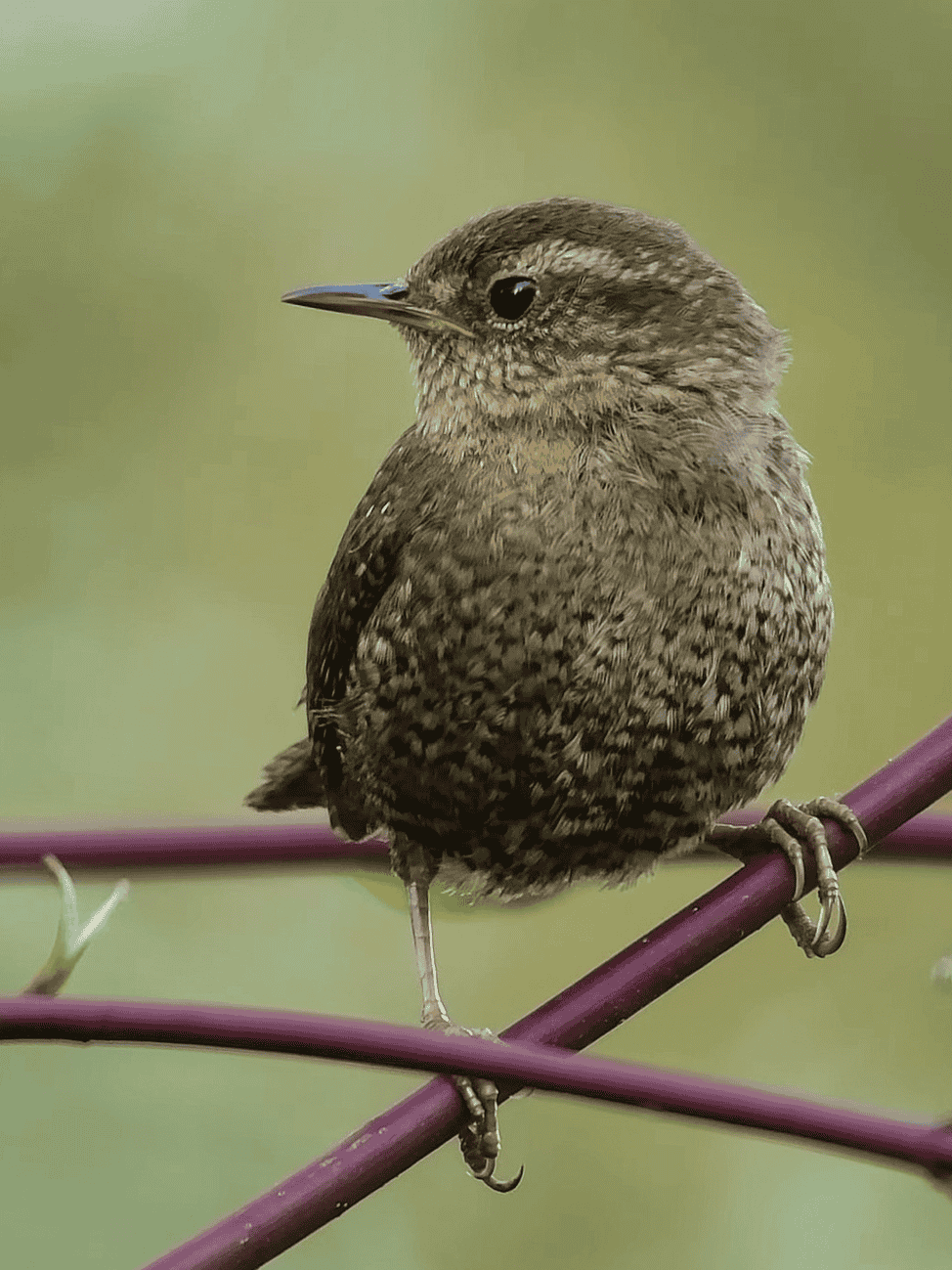
The Winter Wren is a small bird, about 10 cm in length and like a Sparrow in size. It possesses a brown and tan coloration, with stronger dark barring flanks. Its tail is short, and it has a robust, rounded-wing shape. It is generally darker than the Pacific Wren but possesses a contrasting pale throat.
Male vs female
There is little to no sexual dimorphism observed in Winter Wrens, meaning males and females appear similar. Both genders exhibit the same coloration and tail length. They're usually recognized by their distinctive callnotes.
Juvenile
Juvenile Winter Wrens also bear resemblance to adults, possessing similar coloration. Their dark barring on the flanks might appear less defined. As the little birds mature, they will develop the characteristic throat paleness and distinct call notes of the adults.
Often mistaken for
Pacific Wren vs Winter Wren
Winter Wrens and Pacific Wrens are extremely similar but differ in subtle song and range distinctions. Pacific Wrens have a slightly longer tail and their song is more complex and rapid. Geographically, Winter Wrens are found more in eastern North America, while Pacific Wrens are west of the Rockies.
Bewick’s Wren vs Winter Wren
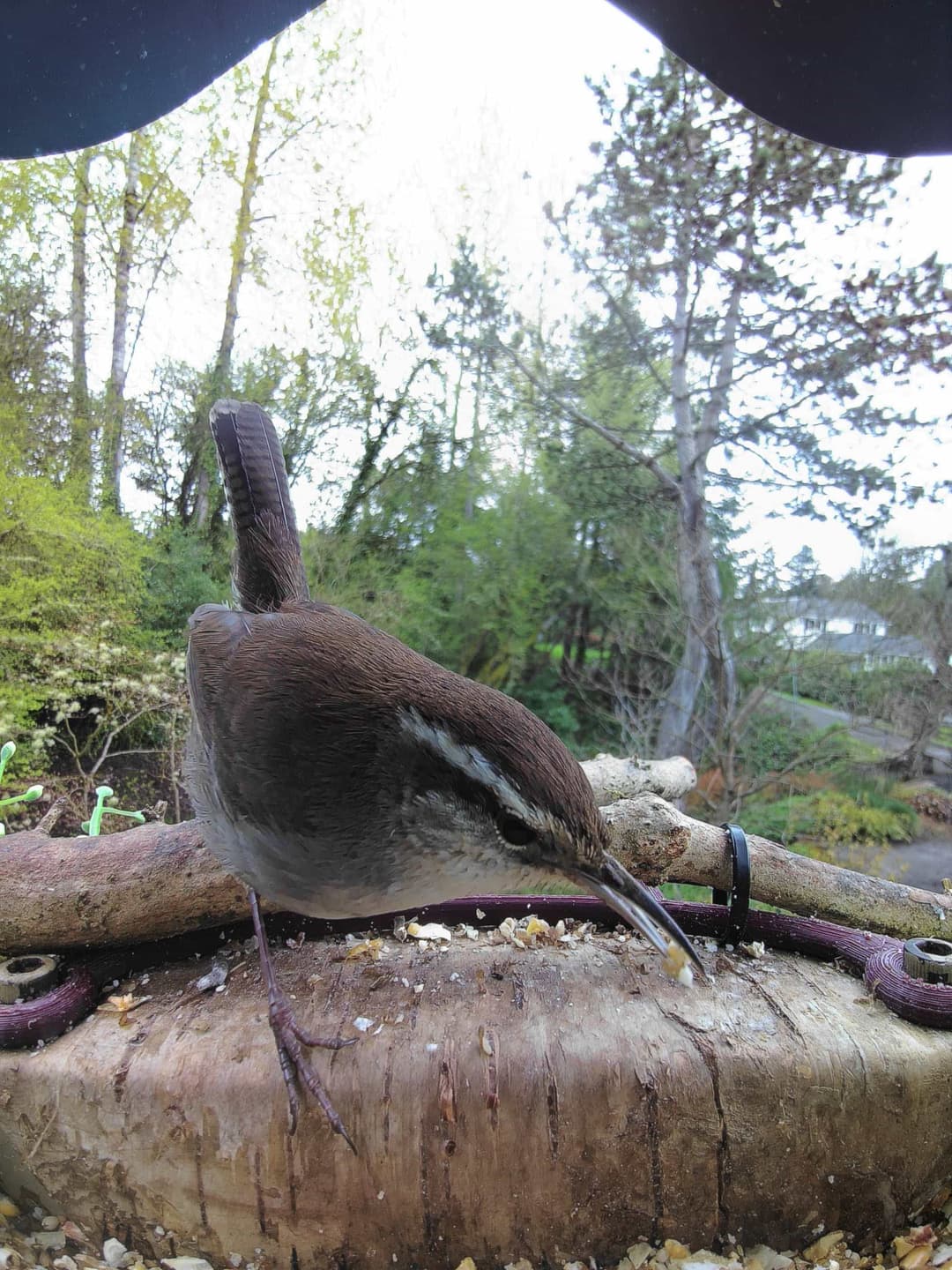
Winter Wrens can be distinguished from Bewick’s Wrens by their stubbier appearance and more uniform brown color. Bewick’s have a bold white eyebrow stripe and longer tails, often cocked upwards. Winter Wrens are generally more reclusive and prefer dense, forested areas.
Breeding and nesting habits of the winter wren
Mating behaviors
Male sings in spring to defend territory and attract a mate. During courtship, he perches near the female with wings half-opened and fluttering, tail spread and moving side to side, while singing or calling. Males may have more than one mate.
Nesting details
Winter wrens nest in natural cavities below 6', such as in roots of fallen trees, rotten stumps, old woodpecker holes, rock crevices, streambanks, and under cabin porches. Both sexes build the nest with grass, weeds, moss, and rootlets, lined with animal hair and feathers. Males may also construct unlined 'dummy' nests.
Eggs and chick-rearing
Female lays eggs within the well-lined nest cavity. Both parents are involved in the care and feeding of the chicks, ensuring their growth and development until fledging.
What does a winter wren like to eat?
Aquatic animals
Berries
Insects
Plants
Snails
Spiders
Natural diet
The winter wren primarily feeds on insects. It consumes a diverse range of insects, including beetles, caterpillars, true bugs, ants, small wasps, and other types. Additionally, it eats many spiders, along with some millipedes and snails. Occasionally, it may consume tiny fish. During fall and winter, it might also eat berries.
Bird feeders
The winter wren typically does not have specific common foods it consumes from bird feeders, as it primarily feeds on natural food sources such as insects and arachnids. However, if you wish to attract them, offering mealworms or suet might be beneficial.
Attract winter wrens with the right snacks
To tempt winter wrens to visit your yard or feeder, fill it with their favorite snacks. They particularly love small insects and spiders but since such delicacies might be hard for you to procure, finely minced suet or mealworms will work as well. Bird Buddy seeds are highly recommended as they are selected by experts to suit seasonal needs of the birds.
Choosing the correct feeder type
Winter wrens prefer ground feeders or platform feeders. They're not much for high perches. They like feeders that are close to thick bushes or other plant cover where they can hide from predators. Locating your feeder near such cover can encourage them to drop by.
Make your yard wren-friendly
Winter wrens prefer yards with plenty of cover. They are fond of dense shrubbery and evergreen trees. A well-landscaped yard with plenty of hiding spaces and bird-friendly plants can be quite inviting to them.
Encourage a sing-along
Winter wrens are known for their beautiful and complex songs. While they mostly sing during breeding season in spring, they will occasionally burst into song in winter. Playing recordings of winter wren songs can sometimes coax these shy birds into a sing-along.
Where can you find winter wrens?

Primary habitat
The Winter Wren prefers moist coniferous forests with an understory of dense thickets, often near water, for breeding in the summer.
Additional range
During winter, it resides in very dense low growth in woods, especially streambanks, or within tangles, brushpiles, and fallen logs.
Do they migrate?
The winter wren (Troglodytes hiemalis) is a migratory bird in North America. Despite its name, the winter wren does not stay in its northern breeding ranges during winter. It breeds in northern coniferous forests across Canada, the northeastern United States, and parts of the Appalachian Mountains. In winter, this species migrates to milder climates in the southeastern United States. The migration of winter wrens occurs relatively early in the spring and late in the fall. This bird moves southward in the fall, generally starting in late September and continuing through October and early November, making its way to wintering grounds in the southeastern United States, including states like Georgia, Florida, and the Carolinas. In spring, winter wrens begin their northward migration earlier than many other bird species, usually returning to their breeding territories from March to early May. The migratory routes of winter wrens tend to follow riparian corridors and forested areas, as these birds prefer dense, moist habitats. Key stopover locations during migration can include forested areas with dense underbrush and areas near water bodies, providing the necessary cover and food resources needed during their journey.
What is the role of winter wrens in nature and how to protect them?
Conservation status
The winter wren is classified as "still widespread and common," indicating it is not currently considered vulnerable or endangered. This species benefits from a stable population and does not face immediate significant threats. Although habitat loss and climate change can pose risks, the winter wren's adaptability to various environments aids its resilience. Conservation efforts focus on habitat preservation and monitoring population trends to ensure long-term stability. Maintaining healthy forest ecosystems is critical to supporting their continued abundance.
Ecological role of winter wrens
Its role in the ecosystem
The Winter Wren is an important part of the ecosystem due to its feeding habits. The bird mainly feeds on a wide variety of insects such as beetles, caterpillars, true bugs, ants, small wasps, spiders, millipedes, and snails, and occasionally, it may feed on small fish. This helps in controlling the population of these organisms, essentially providing pest control in the areas where the Winter Wren resides. It also occasionally feeds on berries, mainly in the fall and winter; this feeding pattern aids in seed dispersal which contributes to plant propagation and biodiversity in its natural habitat. Furthermore, their nesting behavior prompts them to repurpose natural cavities, leading to better use of available spaces in nature.
How to help protect winter wrens
Preservation tips
Habitat preservation strategies for winter wren conservation
To support the conservation of the winter wren, it is essential to preserve their natural habitats. This can be achieved by preventing deforestation and maintaining woodland diversity. Leaving undisturbed leaf litter and fallen logs provide the winter wrens a perfect breeding and feeding ground. Implement policies prohibiting any harmful practices that might disturb the environment in which these birds live. Advocate for protective laws for these areas.
Community science initiatives for winter wren conservation
Engaging the community in initiatives aimed at conserving the winter wren can boost conservation efforts. Establish community science programs where individuals report winter wren sightings and nest locations. This data can be used to monitor population trends and identify critical habitats. Educational programs can raise awareness about the importance of the winter wren and its conservation. Community clean-up programs can also help in maintaining a healthy environment for the winter wrens.